
Fees
Lighter DEX Fees Explained: Zero Fees, Premium Tiers, Withdrawal Costs and Hidden Costs (2026)
Lighter DEX charges 0% maker and 0% taker fees on standard accounts. Here is the full fee schedule: premium LIT tiers, Plus accounts, withdrawal fees, funding, spread and slippage, plus a worked example of what a trade really costs.
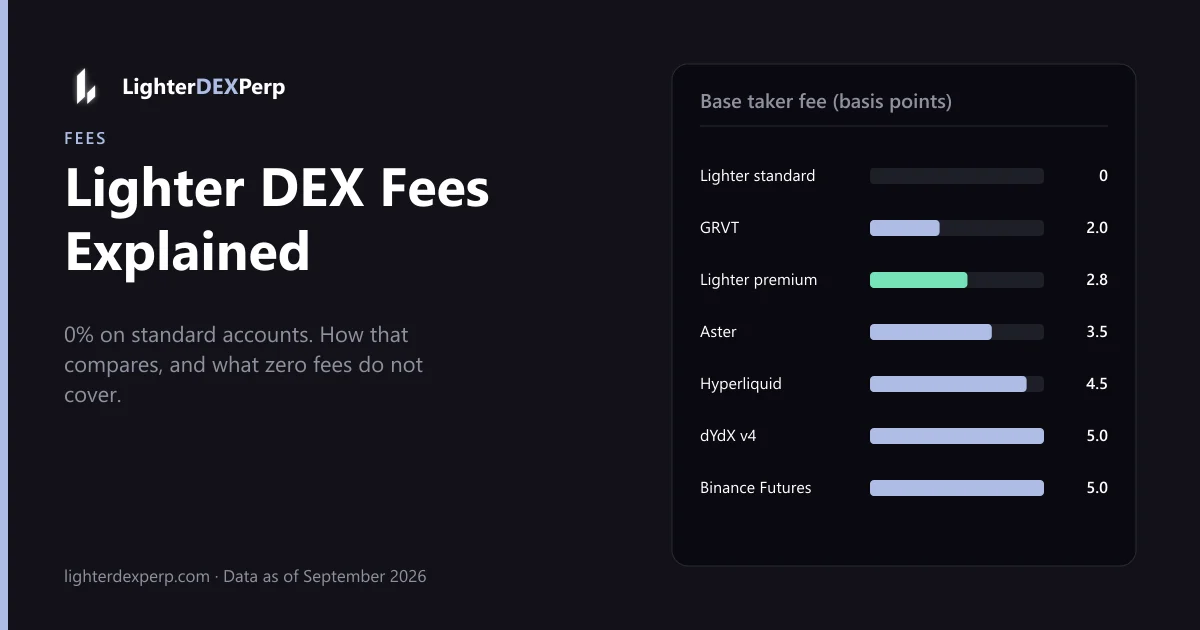
Lighter trading costs 0% maker and 0% taker fees on standard accounts, on every perpetual market, with no volume requirement and no expiry. That means a $10,000 round trip that costs about $9 on Hyperliquid costs you nothing here. "Zero fee" does not mean "zero cost", though, so below you get the full published fee schedule and then the costs that remain and how to keep each one small: funding, spread, slippage, Ethereum gas and the liquidation fee. Verified against docs.lighter.xyz in September 2026.
Lighter fee schedule at a glance
| Account type | Maker fee | Taker fee | Taker latency | Who it is for |
|---|---|---|---|---|
| Standard (default) | 0% | 0% | 300 ms | Everyone. Retail, swing traders, most bots. |
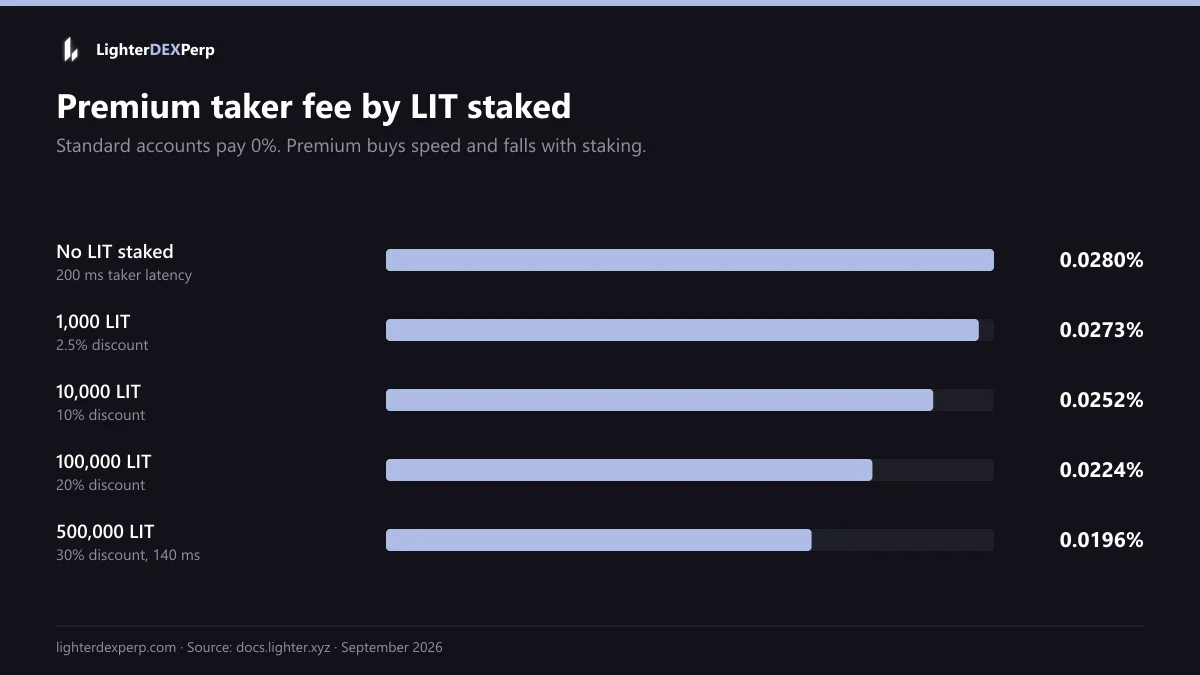
| Premium (0 LIT staked) | 0.0040% | 0.0280% | 200 ms | Market makers and HFT who need speed. |
| Premium, 1,000 LIT | 0.0039% | 0.0273% | 195 ms | 2.5% discount |
| Premium, 10,000 LIT | 0.0036% | 0.0252% | 180 ms | 10% discount |
| Premium, 100,000 LIT | 0.0032% | 0.0224% | 160 ms | 20% discount |
| Premium, 500,000 LIT | 0.0028% | 0.0196% | 140 ms | 30% discount |
| Plus | 0.005% | 0.005% | 300 ms | API traders who need 8,000 sendTx/min rate limits |
Fees are quoted as a percentage of notional. 0.0280% is 2.8 basis points, so a premium taker pays $2.80 per $10,000 traded. A standard taker pays $0.
Standard accounts also get 200 ms maker latency and up to 4 sub-accounts. Premium latency applies per tier; the LIT discount is calculated at the Ethereum address level, so LIT staked from a main account counts for its sub-accounts too.
Standard vs Premium: which should you use?
For almost every human trader the answer is Standard. The only things you give up are 100–160 ms of matching latency and some API throughput. Unless you are running a latency-sensitive market-making strategy where being first in the queue is worth 2.8 bps per taker fill, the free tier is strictly better.
Premium makes sense if:
- You run a market-making bot that needs to update quotes faster than competitors.
- You want the 20% market-maker share of the weekly points pool, which is reserved for premium accounts.
- You already hold LIT and can stake 100,000+ tokens for the 20–30% discount.
Lighter also sells LIT Fee Credits: instead of staking 200,000 LIT to reach the next tier, you can pay an upfront fee for temporary credits that count toward the tier. All proceeds are streamed to LIT stakers as daily rewards.
New accounts created with a Lighter DEX referral code get one week of Premium fees rebated on their first $10 million of volume, paid out on Mondays. It is a trial of premium latency, not a discount on the already-free standard tier.
Does Lighter charge deposit or withdrawal fees?
Lighter does not charge a protocol fee to deposit. Withdrawals to Ethereum L1 carry a small fixed fee that covers the cost of the L1 transaction; accounts that stake at least 100 LIT have withdrawal and internal transfer fees waived. Bridged deposits from Arbitrum, Base, Solana, Avalanche or HyperEVM pay the bridge provider's fee and the source-chain gas.
Practical numbers in September 2026:
- Direct USDC deposit from Ethereum: L1 gas only, typically $1–5 depending on congestion.
- Withdrawal to Ethereum: roughly the L1 gas cost, often $1–3, waived with 100+ LIT staked.
- Minimum deposit: 5 USDC (or 0.001 ETH).
How to do each step is in the Lighter DEX wallet and deposit guide.
The costs zero fees do not remove
1. Funding payments
Every perp exchange charges or pays funding to keep the contract price near the index. On Lighter funding settles every hour, computed from the average premium of mark over index during the hour, divided by 8 so the hourly rate is one-eighth of an 8-hour rate. It is capped at 0.5% per hour (4% per 8 hours). If you hold a long in a market where longs are crowded, you pay. Over a week at a 0.01% hourly rate, a $10,000 position pays about $17, far more than any trading fee you avoided.
Stock, FX and commodity perps use a funding multiplier of one half, and pre-IPO markets one hundredth, so funding on those markets is much gentler. Full mechanics: Lighter DEX funding rate.
2. Spread
Zero fees do not mean you buy and sell at the same price. On BTC and ETH the Lighter book is usually 1 tick wide (a few dollars on BTC), so a market round trip costs roughly $0.50–$1 per $10,000. On mid-cap alts, stocks and pre-IPO markets the spread can be 10–60 bps, which is the real cost of trading those markets. A $10,000 round trip on the Anthropic pre-IPO perp can cost $40–70 in spread even though the fee line says $0.
3. Slippage
Market orders larger than the top-of-book liquidity walk the book. Lighter's depth on majors is competitive with Hyperliquid inside $1 million; beyond that, oversized orders in mid-caps move Lighter's book further. Use limit orders or TWAP orders for size. See the Lighter DEX trading guide.
4. Liquidation fee
If your account is partially liquidated and the liquidation engine fills you better than the "zero price" it needs, it keeps up to 1% of the difference as a liquidation fee paid to the LLP insurance fund. Full liquidations pass the position to LLP at bankruptcy price. The fee is zero if you never get liquidated.
5. Gas
Deposits and withdrawals require Ethereum L1 transactions. Trading, order cancels and internal transfers between sub-accounts are free L2 transactions.
Worked example: what a $10,000 BTC trade costs on Lighter vs Hyperliquid
Assume a market buy and a market sell of $10,000 notional in BTC-PERP, held for 8 hours at a 0.01% funding rate, spread of 1 tick.
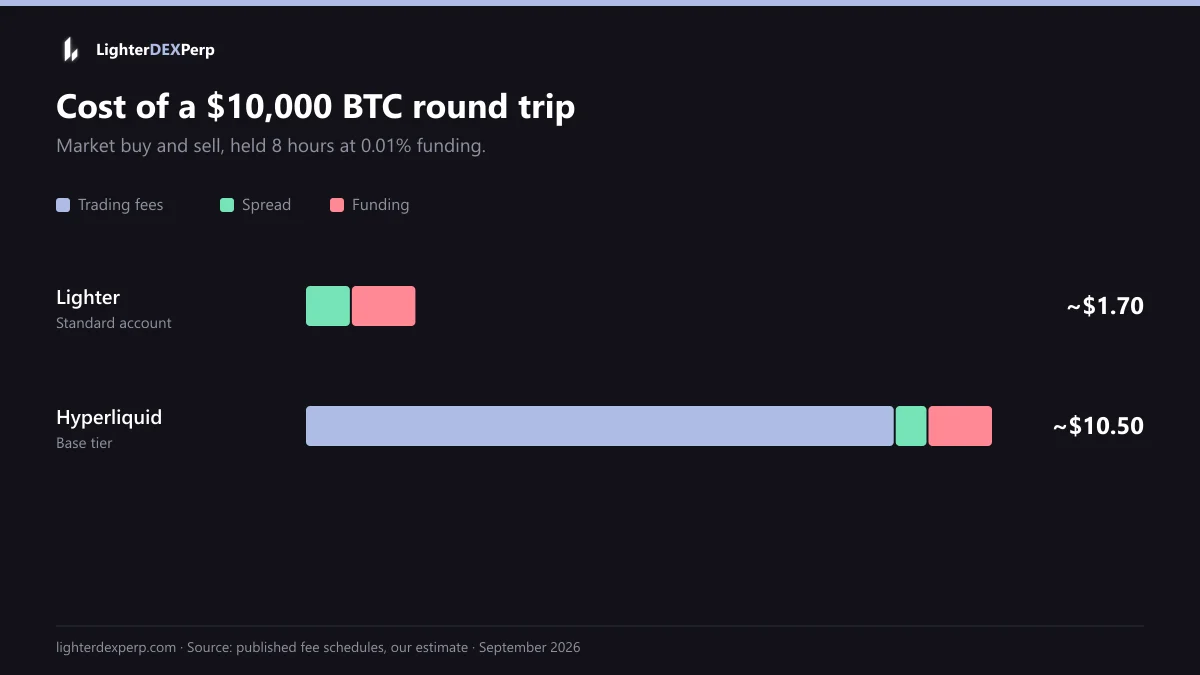
| Cost item | Lighter (standard) | Hyperliquid (base tier) |
|---|---|---|
| Taker fees, round trip | $0.00 | $9.00 (0.045% × 2) |
| Spread, round trip | ~$0.70 | ~$0.50 |
| Funding, 8h | ~$1.00 | ~$1.00 |
| Total | ~$1.70 | ~$10.50 |
Hyperliquid's fees fall with volume tiers and HYPE staking, but a retail account trading under $5 million a month never gets close to zero. That gap is the whole reason Lighter attracted scalpers, grid bots and delta-neutral funding farmers in 2026. Full head-to-head: Lighter DEX vs Hyperliquid.
How does Lighter DEX make money with zero fees?
This is the question skeptics ask, and the answer has become clearer since the token launched:
- Premium and Plus fees from market makers and API traders. Because market makers account for a large share of notional, 2–3 bps on that flow is real revenue.
- Liquidation fees flowing to LLP, where the protocol earns a share.
- LIT fee credits, which stakers receive but which drive token demand that the treasury benefits from.
- Circle partnership (February 2026): Lighter shares in the yield on roughly $900 million of USDC held on the platform, estimated at $40 million annualized at early-2026 rates.
- Robinhood revenue share: fees on the Robinhood Chain deployment are split 50/50.
Protocol revenue was about $26 million annualized by mid-2026 before the Circle and Robinhood contributions, and cumulative LIT buybacks reached $17.9 million by the end of Q1 2026. See Lighter DEX volume.
Fee comparison with other perp DEXs
| Exchange | Standard maker / taker | Best published tier |
|---|---|---|
| Lighter | 0% / 0% | 0.0028% / 0.0196% (premium, 500k LIT) |
| Hyperliquid | 0.015% / 0.045% | 0% / 0.024% (>$7B volume + staking) |
| Aster | 0.01% / 0.035% | VIP tiers |
| dYdX v4 | 0.01% / 0.05% | 0% / 0.02% |
| GRVT | 0% / 0.02% | tiered |
| Binance Futures (CEX) | 0.02% / 0.05% | 0% / 0.017% (VIP 9) |
Only Lighter offers a genuinely free standard tier with no strings attached, and it is the only one where the free tier is the default rather than a promotion.
Frequently asked questions
Is Lighter DEX really free to trade? Yes. Standard accounts pay 0% maker and 0% taker on every market. You still pay funding, spread, gas on deposits and withdrawals, and a liquidation fee if you are liquidated.
Does Lighter have a withdrawal fee? A small fixed fee that covers the Ethereum L1 transaction, waived for accounts staking 100 or more LIT. Deposits have no protocol fee.
What are Lighter premium fees? 0.0040% maker and 0.0280% taker without staking, falling to 0.0028% / 0.0196% with 500,000 LIT staked. Premium buys 140–200 ms taker latency instead of 300 ms.
Do referral codes reduce Lighter fees? Standard fees are already 0%. A referral code gives new users one week of premium-fee rebates on their first $10 million of volume.
Does Lighter charge funding fees? Yes, hourly, like every perpetual exchange. Funding is a payment between longs and shorts, not a fee Lighter keeps.
Is Lighter cheaper than Hyperliquid? For any account below Hyperliquid's top volume tier, yes, by roughly 4.5 bps per taker fill. Spread and depth matter more than fees for very large orders.
Related guides
Related Lighter DEX guides
Basics
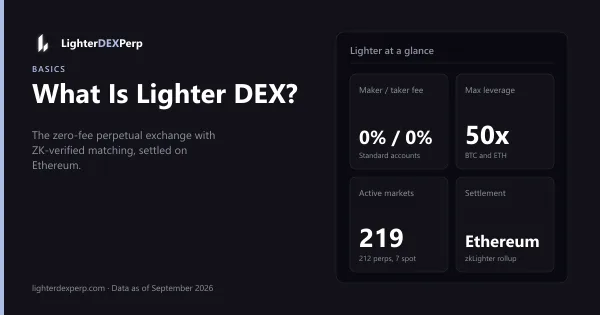
What Is Lighter DEX? The Zero-Fee ZK Perp Exchange Explained (2026)
Plain-English explanation of Lighter: the ZK rollup, the zero-fee model, the 219+ markets, the LIT token and the risks.
9 min read · Updated
Basics
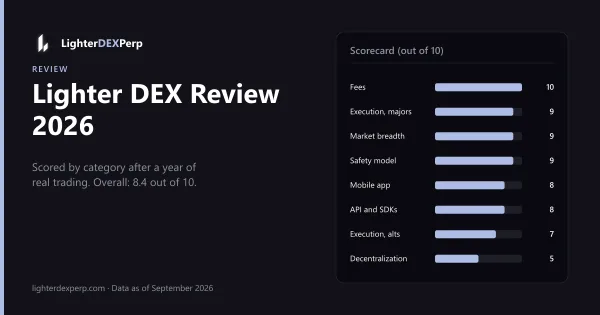
Lighter DEX Review 2026: Pros, Cons, Fees, Liquidity, Safety and Who It Is For
A year of real use distilled: what is excellent, what is merely fine, what is missing, scored by category, with a verdict per trader type.
6 min read · Updated
Basics
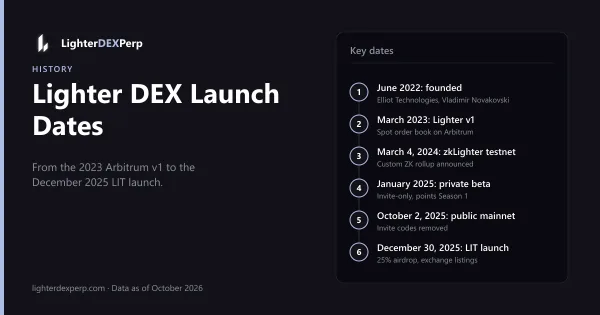
Lighter DEX Launch Date and History: From Arbitrum v1 to zkLighter, Mainnet and the LIT Listing
The full dated timeline: 2022 founding, the Arbitrum v1, the zkLighter testnet, private beta, the October 2025 mainnet, the December 30 2025 LIT launch and listings, and what changed in 2026.
6 min read · Updated