
Trading
Lighter LLP Vault and Staking: How the Liquidity Pool Works, APY, Risks and the LIT Unlock (2026)
The Lighter Liquidity Pool (LLP) is Lighter DEX's market-making and insurance vault. Learn how deposits work, why you need to stake LIT to deposit (1 LIT = 10 USDC), how the crypto/FX/commodity buckets are separated, historical APY, public pools and the risks.
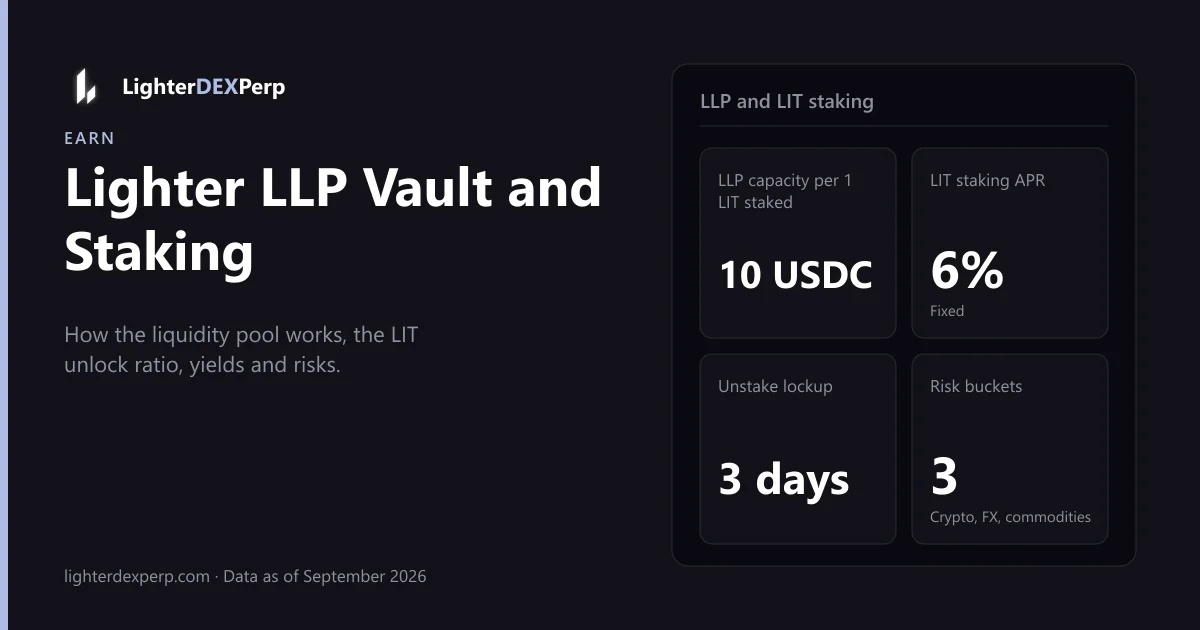
The Lighter Liquidity Pool (LLP) is the vault at the center of Lighter DEX, and it is how you earn from the exchange's activity without placing a trade. It quotes liquidity on the order books, absorbs liquidated positions as the insurance fund, and pays depositors the resulting spread, funding and liquidation-fee income. Since token launch, depositing requires staking LIT: 1 LIT staked unlocks 10 USDC of LLP capacity. Below you get what LLP actually does with your money, how the February 2026 split into crypto, FX and commodity buckets changed the risk, what yields have looked like, how "public pools" differ, and what can go wrong. Verified September 2026.
What LLP is
LLP is Lighter's equivalent of Hyperliquid's HLP: a protocol-run vault that
- Makes markets. LLP posts bids and asks across Lighter's markets, especially newer and thinner ones where third-party market makers are absent. It earns the spread and any funding on inventory it holds.
- Backstops liquidations. When an account is fully liquidated, LLP takes over the position at bankruptcy price and unwinds it. It also collects the up-to-1% liquidation fee on partial liquidations.
- Absorbs losses before ADL. If a bankrupt position cannot be unwound at a profit, LLP eats the loss. Only if LLP is exhausted does auto-deleveraging hit other traders.
Depositors receive LLP shares whose value tracks the pool's net asset value. When traders lose to liquidations or pay spread, NAV rises. When LLP is stuck with losing inventory in a crash, NAV falls.
As market-maker participation has grown, Lighter has said LLP "mostly acts as a liquidity backstop today" rather than the primary quoter on majors. That shifts its income mix toward liquidation revenue and away from spread.
How to deposit into LLP
- Acquire LIT and hold it on Ethereum in the wallet connected to Lighter.
- Stake LIT on the Staking page. For every 1 LIT staked you may deposit up to 10 USDC into LLP. Want $50,000 in LLP? Stake 5,000 LIT.
- Open the LLP / Earn page, pick the bucket (see below), and deposit USDC from your available balance.
- Shares appear immediately. Withdrawals from LLP are subject to a short cooldown; unstaking LIT itself has a 3-day lockup.
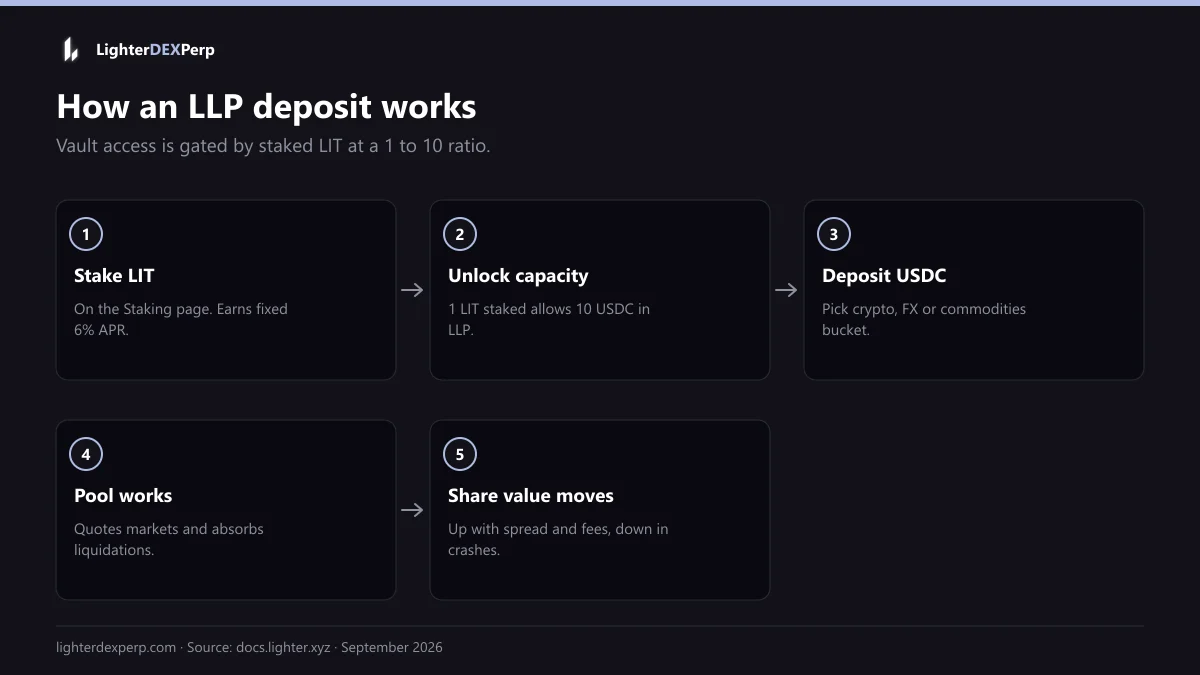
Staked LIT also earns a fixed 6% APR plus streamed proceeds from the LIT fee-credit program, so an LLP depositor effectively earns LLP yield on the USDC plus staking yield on the LIT, minus LIT price risk. Full token mechanics: Lighter DEX tokenomics.
The February 2026 bucket split
In February 2026 Lighter separated LLP into distinct buckets for crypto, FX and tokenized commodities. Each bucket is a segregated risk shard: its liquidations, funding, inventory and ADL are managed at the strategy level. A blow-up in an illiquid alt no longer dents the FX depositors' NAV, and the crypto bucket can deploy more aggressively into newly listed markets without exposing the whole pool.
For depositors this means choosing an exposure:
| Bucket | Income sources | Risk profile |
|---|---|---|
| Crypto | Spread on 200+ crypto perps, crypto liquidations | Highest yield, highest drawdown in crashes |
| FX | Spread on EURUSD, USDJPY etc., FX funding | Low volatility, lower yield |
| Commodities | XAU, PAXG, oil spread and funding | Moderate, event-driven |
Stock perps and pre-IPO markets are handled within the RWA structure; check the app for the current bucket list because Lighter has added buckets as market classes grew.
LLP APY: what to expect
Historical figures reported by on-chain trackers:
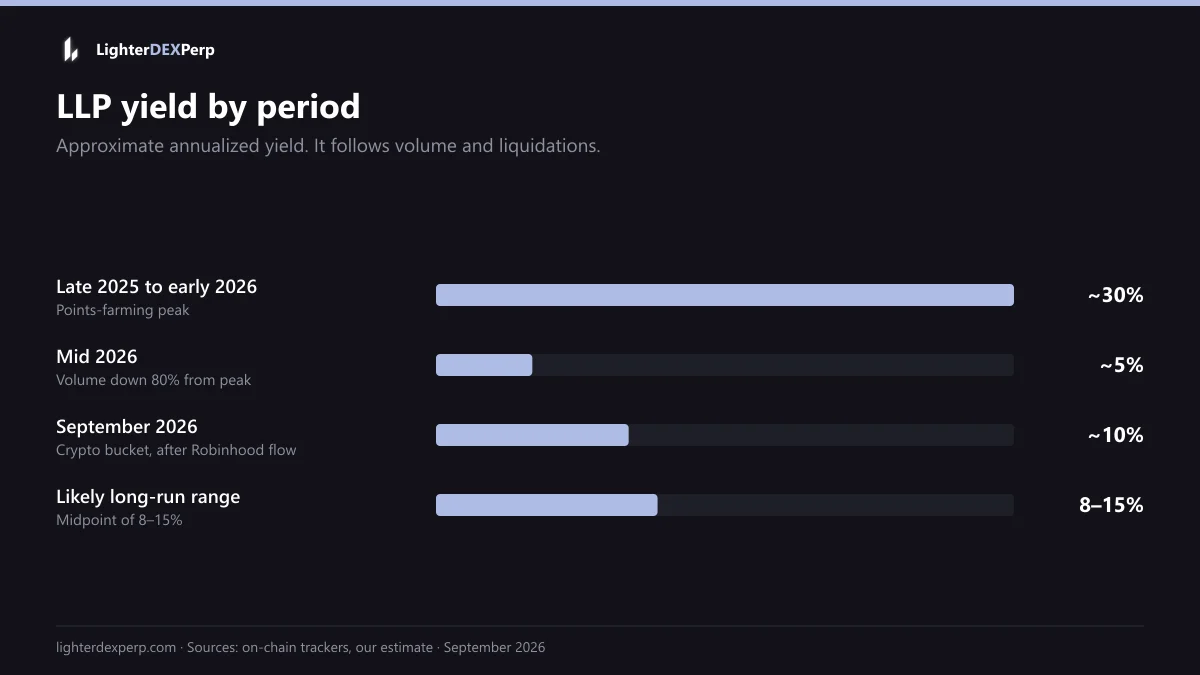
- Late 2025 to early 2026: roughly 30% APY with $700 million+ TVL during the points-farming peak, when liquidations were frequent and spreads on new listings were wide.
- Mid 2026: trackers showed about 5% APY over trailing 30 days as volume fell 80% from peak and market makers took over majors.
- September 2026: yields recovered with the Robinhood-driven volume rebound; the crypto bucket has been in the high single digits to low teens annualized, FX lower.
A sustainable long-run range for a perp-DEX backstop vault is probably 8–15%, with the 30% period being an early-stage bonus. Anyone quoting a fixed LLP APY is quoting a snapshot. The in-app Earn page shows trailing 7-day and 30-day returns per bucket.
Public pools vs LLP
Lighter also supports Public Pools: vaults run by third-party managers (market makers or strategy teams) that anyone can deposit into, with the manager's strategy running on Lighter's zero-fee book. Public pools are not the insurance fund and do not require LIT staking; they are closer to copy-trading vaults. Each has its own fee, lockup and track record, listed on the Earn page. They carry manager risk (strategy losses) rather than liquidation-backstop risk.
If you want exposure to Lighter's liquidation flow, use LLP. If you want a specific manager's strategy, use a public pool. Curated stablecoin vaults on aggregators such as Trading Strategy also route into Lighter pools.
Risks of LLP
- Drawdowns in crashes. LLP inherits losing positions at bankruptcy price. In a fast crash with thin books it may unwind at a loss. HLP has had double-digit-percent drawdown days; LLP's bucket structure limits contagion but not the crypto bucket's own exposure.
- ADL is downstream of LLP. If LLP is exhausted, other traders are deleveraged, not depositors; but by then LLP NAV has already fallen.
- LIT price risk. Your deposit capacity is tied to staked LIT. If LIT halves, your capital is unaffected but the value of the stake you had to buy is.
- Lockups. LLP withdrawal cooldown plus the 3-day LIT unstake lockup means you cannot exit everything instantly.
- Smart-contract and circuit risk. LLP logic runs in the same proven system as matching, which is a strength for correctness but not immunity from bugs.
- Yield compression. As professional market makers crowd out LLP on liquid markets, its income depends increasingly on liquidations and new listings.
LLP vs Hyperliquid HLP
| Lighter LLP | Hyperliquid HLP | |
|---|---|---|
| Access | Requires LIT staking (1:10) | Open |
| Structure | Segregated buckets (crypto, FX, commodities) | Single pool with sub-strategies |
| Role | Backstop + market making on thin markets | Primary market maker + liquidator vault |
| Historical yield | 5–30% depending on period | Mid-single to double digits; famous drawdowns |
| Fee to depositors | Protocol share of income | Protocol share of income |
| Lockup | Cooldown + 3-day LIT unstake | 4-day lockup |
The LIT-gating is the biggest structural difference: it turns vault demand into token demand, which supports LIT but adds a second asset to your risk.
Frequently asked questions
Do I need LIT to deposit in the Lighter vault? Yes. Each staked LIT unlocks 10 USDC of LLP capacity. Public pools do not require LIT.
What is the Lighter LLP APY? Variable. Roughly 30% at the early-2026 peak, about 5% mid-2026, high single digits to low teens in September 2026. Check the in-app Earn page.
Can LLP lose money? Yes. It takes over liquidated positions and can unwind them at a loss during crashes.
What is the difference between LIT staking and LLP? Staking LIT earns a fixed 6% APR and unlocks LLP capacity. LLP is a separate USDC deposit that earns trading and liquidation income.
Is LLP the same as Lighter's insurance fund? Yes. The docs refer to it as "Liquidations & LLP (Insurance Fund)."
Related guides
Related Lighter DEX guides
Trading
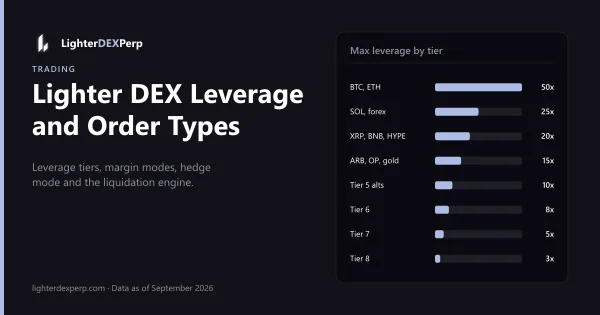
Lighter DEX Leverage, Order Types, Hedge Mode and Liquidations Explained (2026)
Leverage tiers for every market class, margin modes, hedge mode, all order types, how Lighter's zero-price liquidation engine works and where spot fits.
7 min read · Updated
Trading
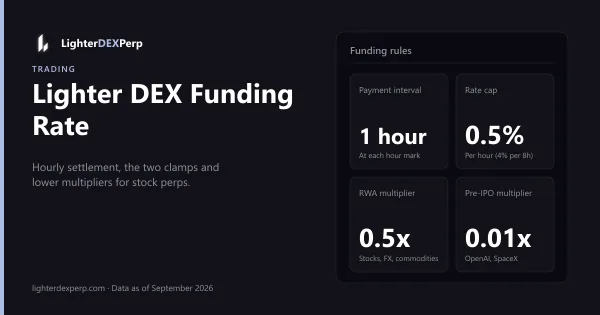
Lighter DEX Funding Rate Explained: Hourly Formula, Caps, History and How to Farm It (2026)
The hourly funding formula, the two clamps, RWA multipliers, how to read funding history, and delta-neutral funding farming on Lighter.
6 min read · Updated
Trading
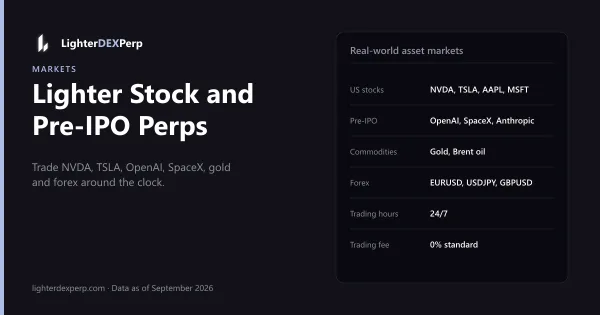
Lighter Stock, Pre-IPO and RWA Perps: Trade NVDA, TSLA, OpenAI, SpaceX, Gold and Forex 24/7 (2026)
How Lighter prices stock, commodity, FX and pre-IPO perps when the underlying market is closed, what leverage and funding apply, and how to trade them sensibly.
5 min read · Updated