
Comparisons
Lighter vs Hyperliquid (2026): Fees, Liquidity, Verifiability, Tokens and Which Perp DEX to Use
A data-driven comparison of Lighter DEX and Hyperliquid: 0% vs 0.045% fees, ZK rollup vs own L1, 219 vs 170+ markets, 50x vs 40x leverage, LLP vs HLP, LIT vs HYPE, volume and TVL, and clear recommendations for each type of trader.
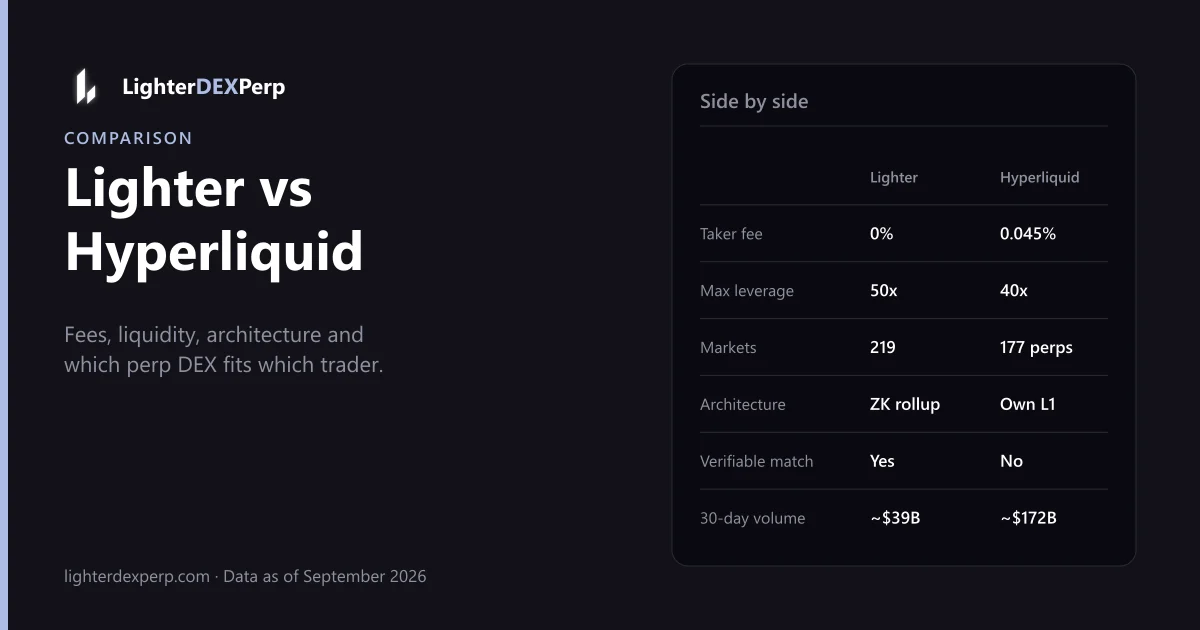
Hyperliquid is the largest perp DEX by volume and liquidity, with roughly $170 billion in 30-day volume, its own Layer 1 and a thriving HyperEVM ecosystem. Lighter is the fastest-growing challenger, with 0% trading fees for standard accounts, a ZK rollup on Ethereum that cryptographically proves every match and liquidation, and a broader menu of stock, FX, commodity and pre-IPO perps. A Lighter trade costs nothing on a standard account, and the exchange briefly overtook Hyperliquid on monthly volume in December 2025 and has held a stable top-five position since.
The short version: Hyperliquid wins on depth, ecosystem and track record. Lighter wins on cost, provable fairness and market breadth. Below are the numbers behind that verdict and which exchange to use for what. Snapshot: September 2026.
Side-by-side comparison
| Lighter | Hyperliquid | |
|---|---|---|
| Standard maker / taker | 0% / 0% | 0.015% / 0.045% |
| Best tier | 0.0028% / 0.0196% (premium, 500k LIT) | 0% / 0.024% (>$7B 14-day volume + 40% HYPE staking discount) |
| Architecture | App-specific ZK rollup (zkLighter) on Ethereum | Own L1 (HyperCore + HyperEVM), HyperBFT consensus |
| Verifiable matching | Yes, ZK validity proofs | No, trust in validator set |
| Settlement / withdrawals | Ethereum L1, escape hatch after 14 days | Native L1, bridge to Arbitrum |
| Max leverage | 50x (BTC, ETH) | 40x |
| Live markets | 219 (212 perps + 7 spot) | ~177 perps, 300+ spot pairs |
| Stocks / pre-IPO / FX | Yes, native | Limited via HIP-3 builder-deployed markets |
| Funding interval | Hourly, cap 0.5%/h | Hourly, cap 4%/h |
| Liquidation backstop | LLP (LIT-gated, bucketed) | HLP (open) |
| Token | LIT, 1B supply, TGE Dec 30 2025 | HYPE, 1B supply, TGE Nov 2024 |
| Buyback | Daily TWAP, burned | Assistance Fund buys with ~97% of fees |
| 30-day volume | ~$39B mid-2026, recovering | ~$172B |
| Peak 30-day volume | ~$232B (Dec 2025) | ~$300B+ |
| TVL | ~$487M | ~$5B+ |
| Open interest | ~$766M | ~$10B+ |
| Funding raised | $89M (Founders Fund, Ribbit, a16z, Robinhood, Dragonfly, Haun, Lightspeed) | None (self-funded, no VC) |
| Launch | Invite-only 2025, public Oct 2025 | 2023 |
| KYC | None | None |
| US access | Blocked | Blocked |
| Mobile app | Yes (iOS, Android) | Via third-party apps and web |
| API / SDK | REST, WS, Python, Go, TypeScript | REST, WS, Python, Rust, TS |
Fees: the biggest difference
On a $10,000 taker round trip, Hyperliquid's base tier costs $9 in fees. Lighter's standard account costs $0. Hyperliquid's tiers fall with 14-day volume and HYPE staking, but a retail trader doing under $5 million a month never gets near zero. Lighter's zero is the default, not a reward.
The catch is that fees are not the whole cost. Hyperliquid's deeper book means slightly tighter spreads on majors in size, and its liquidity holds up better in violent moves. For orders under a few hundred thousand dollars in BTC and ETH, the difference in spread is under a basis point and Lighter's fee advantage dominates. For $5 million clips in a mid-cap, Hyperliquid's depth may be worth more than 4.5 bps. Full Lighter fee breakdown: the Lighter DEX maker taker fee schedule.
Architecture: ZK rollup vs sovereign L1
Lighter runs a single sequencer that matches orders off-chain and generates zero-knowledge proofs (Plonky2 circuits) that every state transition followed the published rules: price-time priority, margin checks, the liquidation waterfall. Ethereum verifies the proofs. Lighter cannot front-run you, fill you off-book or liquidate you above maintenance margin without producing an invalid proof. If the sequencer disappears for 14 days, users withdraw from the Ethereum contract directly.
Hyperliquid runs its own L1 with a validator set using HyperBFT consensus. The matching engine lives in HyperCore; HyperEVM lets developers build on top. Fairness rests on validator honesty and the open-source code, not on cryptographic proofs. Hyperliquid's advantage is that the whole system is one integrated chain with sub-second finality and a composable EVM.
Which is "more decentralized" is debatable. Lighter has one sequencer but Ethereum-anchored proofs and exit guarantees. Hyperliquid has a validator set (small, historically Foundation-heavy) but no proof that matching was fair. Verifiability and decentralization are different properties; Lighter has more of the first, Hyperliquid arguably more of the second. See is Lighter DEX legit?.
Liquidity and volume
Hyperliquid's book is deeper on nearly every market, and its open interest is more than ten times Lighter's. During the March and September 2026 drawdowns, Hyperliquid's spreads on alts held tighter and its liquidation cascades cleared faster. Lighter's volume is more incentive-sensitive: it collapsed 80% after the December 2025 points peak, then rebuilt on Robinhood order flow, which now supplies 12–17% of Lighter's daily volume.
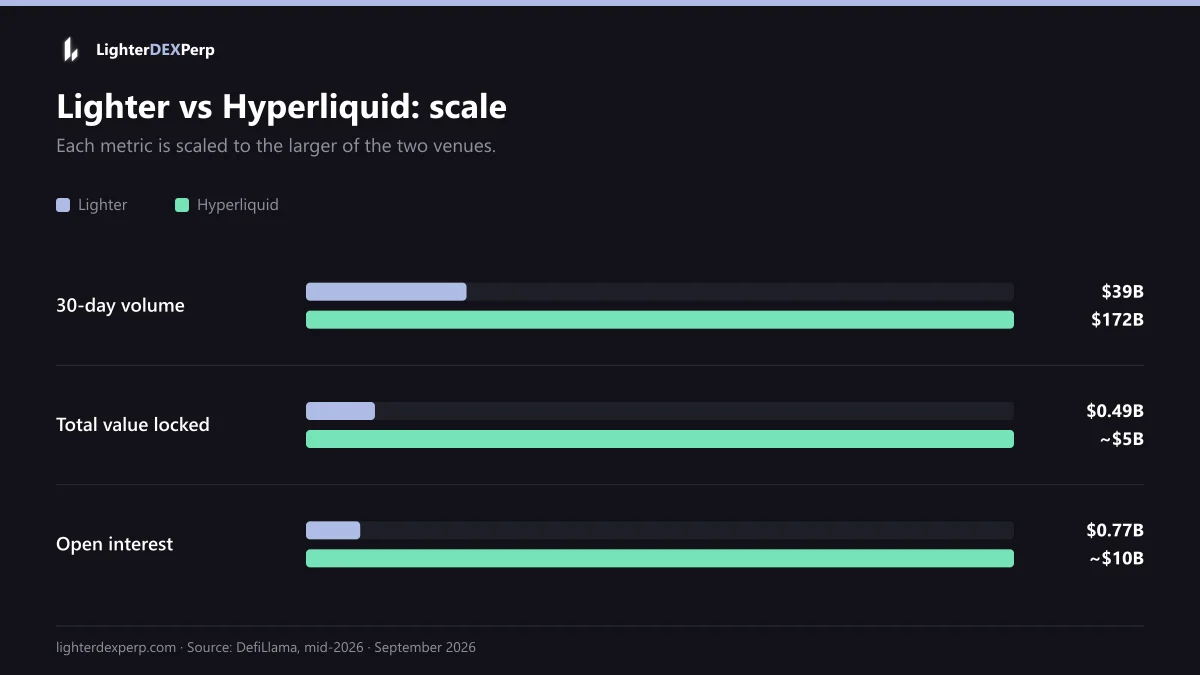
For a retail trader, both venues fill a $50,000 BTC market order at essentially the touch. For a fund, Hyperliquid's depth matters. Data with sources: Lighter DEX data.
Markets and leverage
Lighter lists 219 active markets including US equities (NVDA, TSLA, AAPL, MSFT, GOOGL, META, COIN), pre-IPO perps (OpenAI, SpaceX, Anthropic), gold, oil and five FX pairs, all at zero fees. Hyperliquid's core list is crypto; stocks and commodities exist through HIP-3 builder-deployed markets with their own fee structures. Lighter's 50x on BTC/ETH edges Hyperliquid's 40x, though few traders should use either.
Hyperliquid wins on spot: 300+ spot pairs and a native token-launch ecosystem versus Lighter's 7 spot pairs.
Vaults: LLP vs HLP
Both run a protocol vault that market-makes and backstops liquidations. Hyperliquid's HLP is open to anyone and is the primary market maker on its books. Lighter's LLP requires staking LIT (1 LIT per 10 USDC), is split into crypto, FX and commodity buckets since February 2026, and now acts mostly as a backstop as third-party market makers have crowded majors. HLP has the longer track record and the more famous drawdowns; LLP's bucket structure is a cleaner risk design. Details: Lighter LLP.
Tokens: LIT vs HYPE
| LIT | HYPE | |
|---|---|---|
| Airdrop | 25% of supply at TGE | 31% of supply at TGE |
| Utility | LLP access, premium fee discounts, 6% staking APR | Fee discounts, staking to validators, gas on HyperEVM |
| Value accrual | Trading-fee buybacks, burned since July 2026 | Assistance Fund buybacks (~97% of fees) |
| Unlock overhang | Team/investor cliffs end Dec 2026 | Team unlocks ongoing since Nov 2025 |
| Notable | Bitwise Lighter Staking ETP on Xetra (Sept 2026) | Multiple ETP filings |
HYPE's buyback is larger in absolute terms because Hyperliquid's fee revenue is larger. LIT's mechanism is structurally similar but funded by premium-account fees, liquidation fees and partnership revenue. Full LIT breakdown: Lighter DEX native token.
Points and airdrops
Hyperliquid's points program ended with the November 2024 HYPE airdrop, widely regarded as the most generous in DeFi history. Lighter's first airdrop (December 2025) was the tenth largest ever, and its Season 2 points program is still running with weekly distributions. If you are farming for a future distribution, Lighter is the one with a live program; see the Lighter DEX leaderboard and points guide.
Who should use Lighter
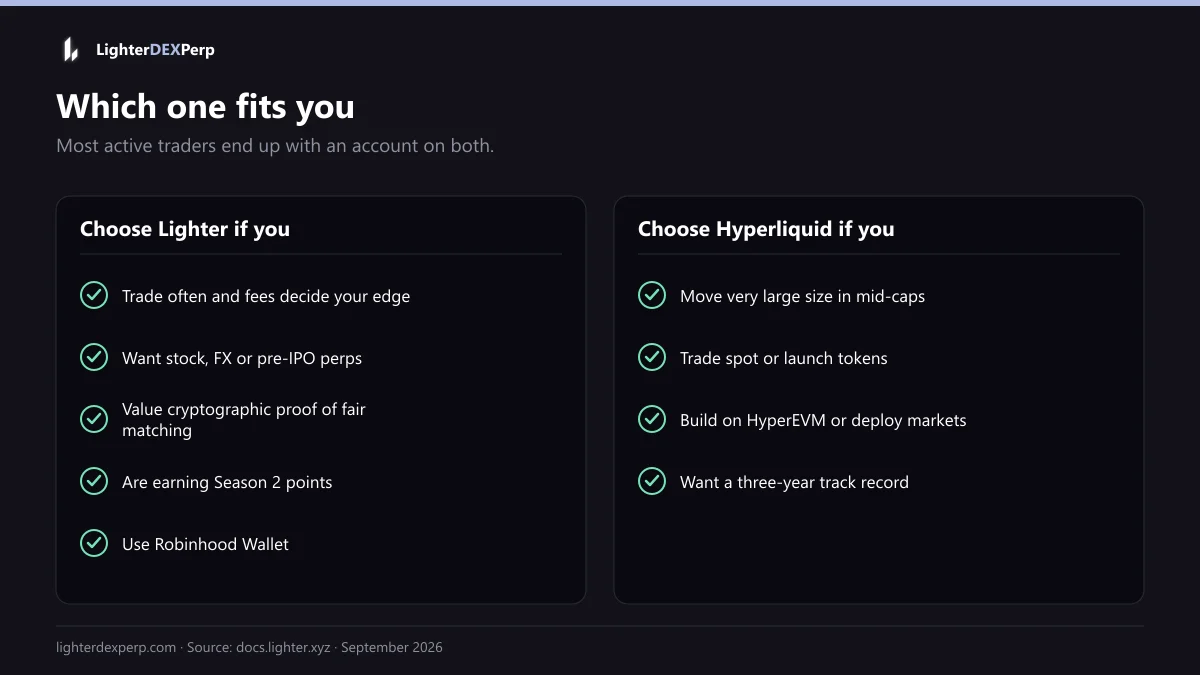
- Retail and mid-size traders for whom 4.5 bps per fill is real money: scalpers, grid bots, hedgers.
- Anyone who wants stock, pre-IPO, FX or commodity perps at zero fees.
- Traders who value a cryptographic guarantee of fair matching over a validator set.
- Points farmers.
- Robinhood Wallet users, who can access Lighter natively.
Who should use Hyperliquid
- Funds and large traders who need the deepest book and the tightest spreads in size.
- Spot traders and token launchers who want HyperEVM composability.
- Anyone who prioritizes a three-year track record and battle-tested liquidation handling.
- Builders deploying their own markets via HIP-3.
Using both
Many active traders keep accounts on both: Lighter for cost-sensitive execution and RWA perps, Hyperliquid for size and spot. Funding rates diverge between the two often enough that a long-on-one, short-on-the-other pair is a common carry trade, and because Lighter charges nothing per fill the arbitrage threshold is lower there.
Frequently asked questions
Is Lighter better than Hyperliquid? For fees and market breadth, yes. For liquidity, ecosystem and track record, Hyperliquid is ahead. It depends on your size and what you trade.
Is Lighter cheaper than Hyperliquid? Yes. Lighter standard accounts pay 0%; Hyperliquid's base tier is 0.015% maker / 0.045% taker.
Which is safer, Lighter or Hyperliquid? Different risks. Lighter has ZK-proven matching and Ethereum exit guarantees but a single sequencer. Hyperliquid has a validator set but unproven matching. Both are non-custodial and unaudited-by-regulators DeFi venues.
Which has more volume? Hyperliquid, by roughly 4x on a 30-day basis in mid-2026. Lighter led briefly in December 2025.
Can Americans use either? No. Both block US users.
Related guides
Related Lighter DEX guides
Basics
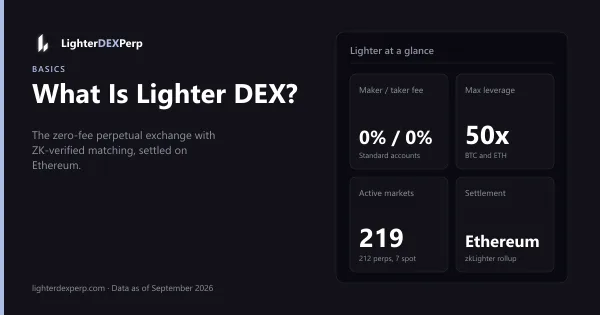
What Is Lighter DEX? The Zero-Fee ZK Perp Exchange Explained (2026)
Plain-English explanation of Lighter: the ZK rollup, the zero-fee model, the 219+ markets, the LIT token and the risks.
9 min read · Updated
Basics
Lighter DEX Review 2026: Pros, Cons, Fees, Liquidity, Safety and Who It Is For
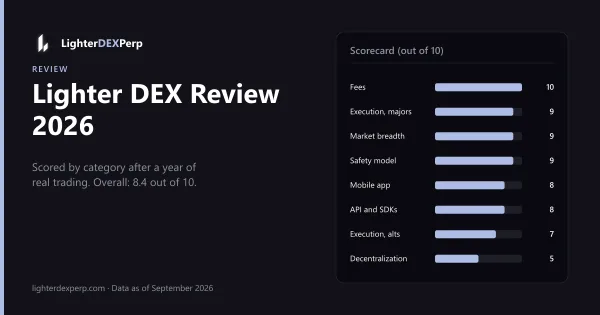
A year of real use distilled: what is excellent, what is merely fine, what is missing, scored by category, with a verdict per trader type.
6 min read · Updated
Basics
Lighter DEX Launch Date and History: From Arbitrum v1 to zkLighter, Mainnet and the LIT Listing
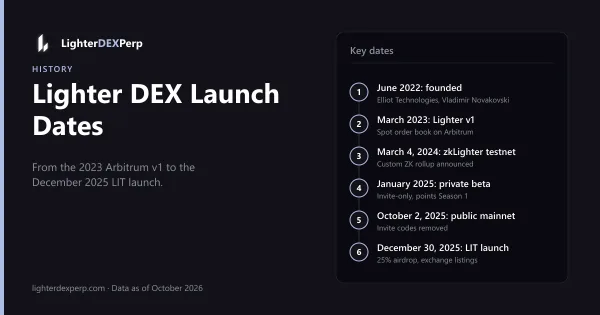
The full dated timeline: 2022 founding, the Arbitrum v1, the zkLighter testnet, private beta, the October 2025 mainnet, the December 30 2025 LIT launch and listings, and what changed in 2026.
6 min read · Updated