
Safety
Is Lighter DEX Safe and Legit? ZK Proofs, Audits, the Escape Hatch, Wash-Trading Claims and Real Risks (2026)
An honest safety review of Lighter DEX: what the ZK proofs actually guarantee, security audits, the 14-day escape hatch, sequencer centralization, LLP and ADL risk, the volume-inflation debate, phishing, and how to protect yourself.
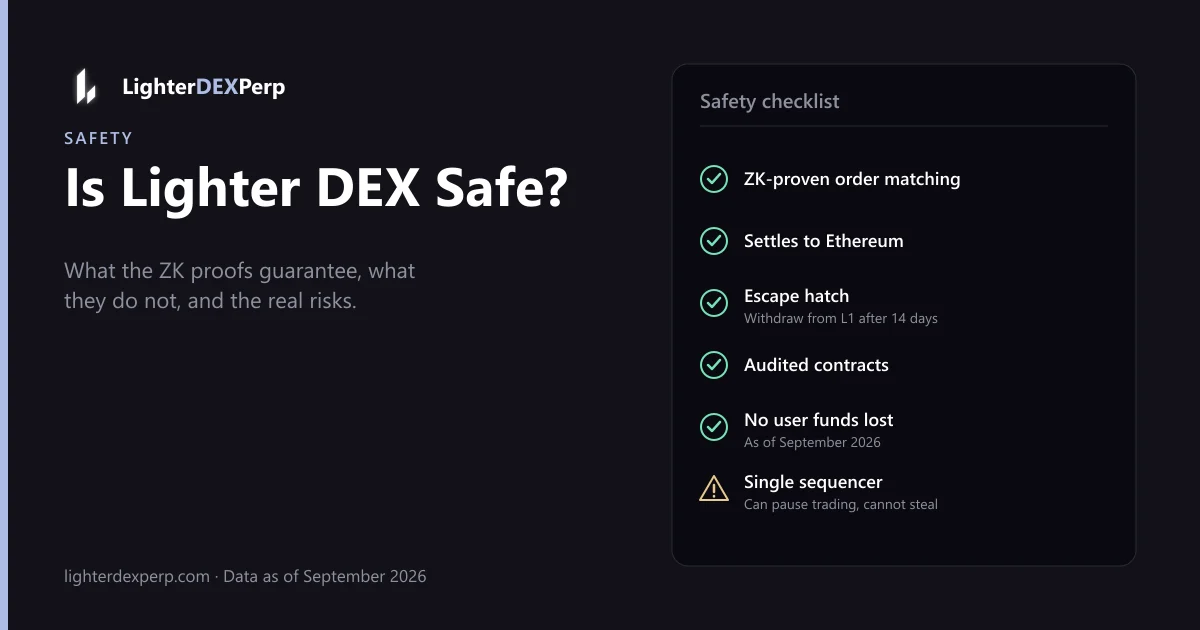
Lighter xyz is legitimate, and here is what that means for your money. It is a venture-backed protocol ($89 million from Founders Fund, Ribbit, a16z, Robinhood Ventures, Dragonfly, Haun and Lightspeed), non-custodial, with audited smart contracts, more than $1.6 trillion in cumulative volume, an ERC-20 token listed on major exchanges and, since September 2026, a Bitwise exchange-traded product on Xetra. On the two things that matter most, custody of your funds and fair matching, Lighter gives you stronger guarantees than a centralized exchange. It still carries the risks of any leveraged DeFi venue plus a few specific to its design. Below you get the guarantees separated from the marketing, and a protection checklist you can apply in five minutes. Verified September 2026.
What the ZK proofs actually guarantee
Lighter runs on zkLighter, an application-specific ZK rollup. The sequencer matches orders off-chain, then generates a validity proof (custom Plonky2 circuits) that the new state was derived from the old state by following the encoded rules. Ethereum verifies the proof before accepting the state root.
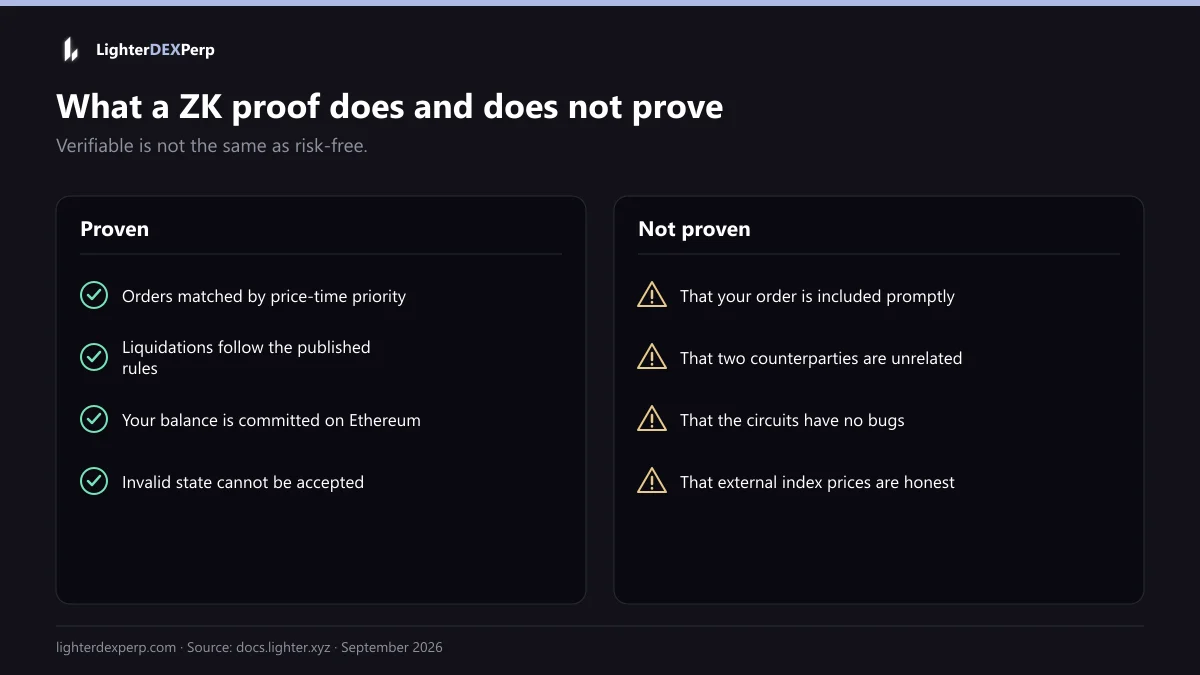
That gives you three hard guarantees:
- Fair matching. Orders match by price-time priority. Lighter cannot skip your order, fill you off-book, or front-run you without producing an invalid proof.
- Fair liquidation. The margin thresholds and the "zero-price" partial-liquidation rule are in the circuit. Lighter cannot liquidate you above maintenance margin or at a worse-than-rule price. See Lighter DEX leverage.
- Your balance is on Ethereum. Every proven state root commits your balance. Lighter cannot alter it without a proof.
What ZK does not guarantee:
- That the sequencer will include your order promptly (it can delay or censor; it cannot fake).
- That two accounts trading with each other are unrelated (wash trading is not a rule violation the circuit checks).
- That the circuits themselves are bug-free.
- That the index prices feeding the mark are honest (they come from external oracles, as on every venue).
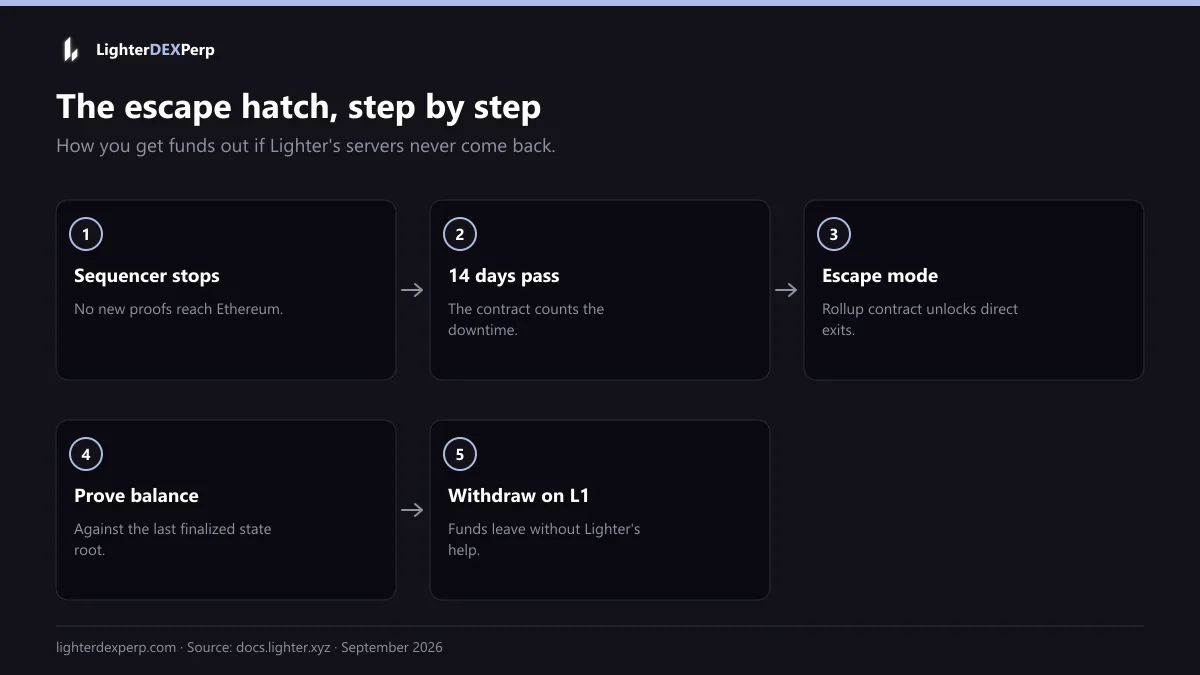
The escape hatch: what happens if Lighter disappears
If the sequencer stops posting proofs for 14 days, the rollup contract on Ethereum enters an escape-hatch mode (some call it desert mode). Any user can submit a proof of their balance in the last finalized state and withdraw directly from the L1 contract, without Lighter's cooperation. This has never been triggered, but it is the property that makes "non-custodial" more than a slogan. Hyperliquid, by contrast, relies on its validator set continuing to operate; a CEX relies on staying solvent and honest. See the Lighter DEX withdrawal guide.
Audits and security program
Lighter publishes a Security Audits page and a Vulnerability Disclosure Policy in its docs. Smart contracts and circuits have been reviewed by external firms, and there is a disclosure process for researchers. As of September 2026 there has been no exploit, hack or loss of user funds on Lighter. That is a good record for a venue that has handled over $1.6 trillion in volume, and it is also a young record; the protocol went public in October 2025.
The real risks, ranked
1. Sequencer centralization
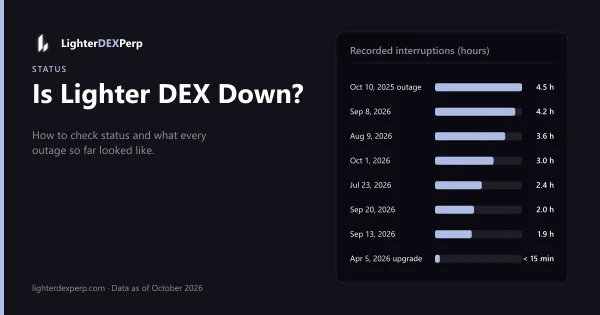
Lighter runs the only sequencer. It can pause trading, delay withdrawals (up to 14 days before the escape hatch), and choose ordering within its rules. It cannot steal or misprice. Brief maintenance pauses have occurred around upgrades. If you cannot tolerate a possible multi-hour pause during a crash, size accordingly.
2. Smart-contract and circuit risk
Novel ZK code is complex. Audits reduce but do not eliminate the chance of a bug in the circuits or the Ethereum contracts. A circuit bug could in theory allow an invalid state to be proven. This is the tail risk of every ZK rollup.
3. LLP and auto-deleveraging
When a position is fully liquidated, the LLP insurance pool absorbs it. If LLP cannot cover a bankrupt position, ADL closes profitable traders on the other side at their zero prices. ADL is fair by construction but means a winning position in an illiquid market can be closed early during a crash. Deposit risk for LLP depositors is separate: the pool can lose money. See Lighter DEX vault.
4. Leverage
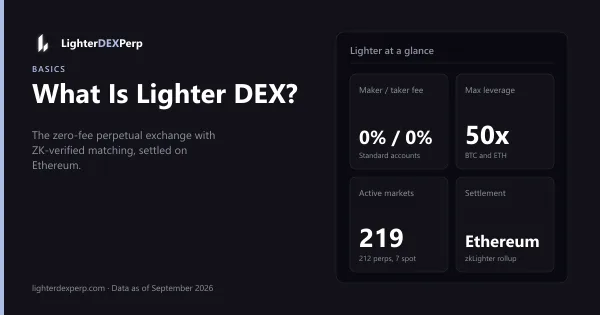
Most losses on Lighter are self-inflicted. 50x on BTC means a 2% move liquidates you. The engine is provably fair; it is not gentle.
5. Token and unlock risk
LIT's FDV is roughly 4x its market cap; team and investor tokens begin unlocking in December 2026. Relevant if you hold LIT or stake it for LLP access. See Lighter DEX token.
6. Regulatory and geographic risk
Lighter is a US-incorporated company operating a venue that blocks US users. Its founder sits on a CFTC advisory committee and Lighter is pursuing a compliant US path, which cuts both ways: regulatory engagement reduces the chance of a sudden shutdown but could change terms for existing users. See Lighter DEX restricted countries.
7. Phishing and fake apps
The largest practical risk for most users is not the protocol; it is a fake app.lighter.xyz clone, a fake APK, or a Discord DM "from support." Lighter will never DM you first or ask for a seed phrase.
The wash-trading and volume-inflation debate
During the December 2025 volume peak, critics argued that a large share of Lighter's $232 billion monthly volume was points-driven wash trading. Two things are true at once:
- A ZK proof verifies that every match followed the rules; it cannot verify that the counterparties were unrelated people. So "verifiable" does not mean "organic."
- Lighter's points program penalizes self-trading and Sybil clusters, enforces self-trade prevention, and the volume did fall ~80% when incentives cooled, then rebuilt on Robinhood retail flow that is clearly not points farming.
The honest reading: some of the peak volume was incentive-driven, as on every points program in DeFi history; the current volume base is more organic; and neither the critics' nor Lighter's framing is entirely right. Data: Lighter DEX volume.
Is Lighter DEX a scam?
No. Named founder with a verifiable Citadel and Lunchclub history, disclosed investors, public GitHub, audited contracts, a token on major exchanges, a Bitwise ETP, an integration with Robinhood, and no incident of user-fund loss. Scam claims online usually trace to users who were liquidated at high leverage or who used a phishing site.
How to protect yourself on Lighter
- Bookmark app.lighter.xyz and never follow links from DMs or ads.
- Use a hardware wallet for the L1 address; the sign-in message and API keys do not expose your seed.
- Isolated margin and a stop-loss on every leveraged position.
- Keep leverage under 10x unless you are a professional. The tiers allow 50x; nothing requires you to use it.
- Do not keep your whole stack on the rollup. Withdraw profits to L1 periodically.
- Read the funding rate before holding overnight; see Lighter DEX funding rate.
- Enable mobile liquidation alerts in the Lighter DEX app.
- Verify the LIT contract address from official sources before buying on a DEX.
- Support only through the official Discord ticket system. See Lighter DEX support.
Lighter vs CEX vs other DEXs on safety
| Risk | Lighter | Centralized exchange | Hyperliquid |
|---|---|---|---|
| Custody | Non-custodial, Ethereum-anchored | Custodial | Non-custodial on own L1 |
| Fair matching | ZK-proven | Trust | Validator trust |
| Exit if operator fails | Escape hatch after 14 days | None | Validator-dependent |
| Operator can pause | Yes (sequencer) | Yes | Validators can halt |
| Audits | Yes | Varies | Yes |
| Insurance fund | LLP | Exchange fund | HLP |
Frequently asked questions
Is Lighter DEX private? No. Lighter uses zero-knowledge proofs for verifiability, not for privacy. Accounts are tied to Ethereum addresses, and trades, positions and balances are reconstructable from the data Lighter posts to Ethereum. Treat your activity as public, as on any transparent DEX.
What happens if Lighter goes down? Trading freezes at the last state and funds stay in the Ethereum contract. Incident history and how to check status: Lighter DEX status.
Is Lighter DEX safe to use? As safe as a well-designed non-custodial venue can be: ZK-proven matching, Ethereum settlement, audits, an escape hatch. The main risks are leverage, sequencer pauses and phishing.
Has Lighter DEX been hacked? No incident of user-fund loss has occurred as of September 2026.
Is Lighter DEX legit? Yes. Disclosed founder and investors, audited code, $1.6T+ volume, Robinhood integration, Bitwise ETP.
Can Lighter freeze my funds? It can pause the sequencer, delaying withdrawals. After 14 days the escape hatch lets you withdraw from Ethereum without Lighter.
Does Lighter have insurance? The LLP pool acts as the insurance fund for liquidations. There is no deposit insurance.
Related guides
Related Lighter DEX guides
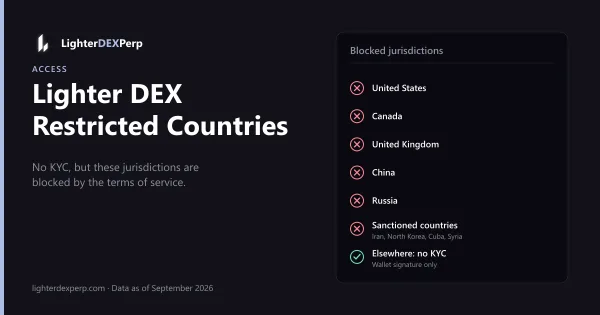
Safety
Lighter DEX Restricted Countries, KYC and Terms: Who Can Trade (US, UK, Canada, China and More) (2026)
The blocked-jurisdiction list from Lighter's terms, how geo-blocking works, KYC (none), VPN policy, and the CFTC-driven outlook for US access.
4 min read · Updated
Safety
Is Lighter DEX Down? How to Check Status, Incident History and What Happens to Your Funds (2026)
Where to check status, every recorded outage and liveness anomaly with dates and durations, what happens to positions and withdrawals during a pause, and the escape hatch.
5 min read · Updated
Basics
What Is Lighter DEX? The Zero-Fee ZK Perp Exchange Explained (2026)
Plain-English explanation of Lighter: the ZK rollup, the zero-fee model, the 219+ markets, the LIT token and the risks.
9 min read · Updated