
Developers
Lighter DEX Trading Bots: Grid, Market-Making, Funding Arbitrage and How to Build One Safely (2026)
How to run a trading bot on Lighter DEX: why zero fees change bot economics, the strategies that work (grid, market making, funding arbitrage, TWAP execution), which account tier you need, open-source starting points, and the risk controls that keep a bot from liquidating you.
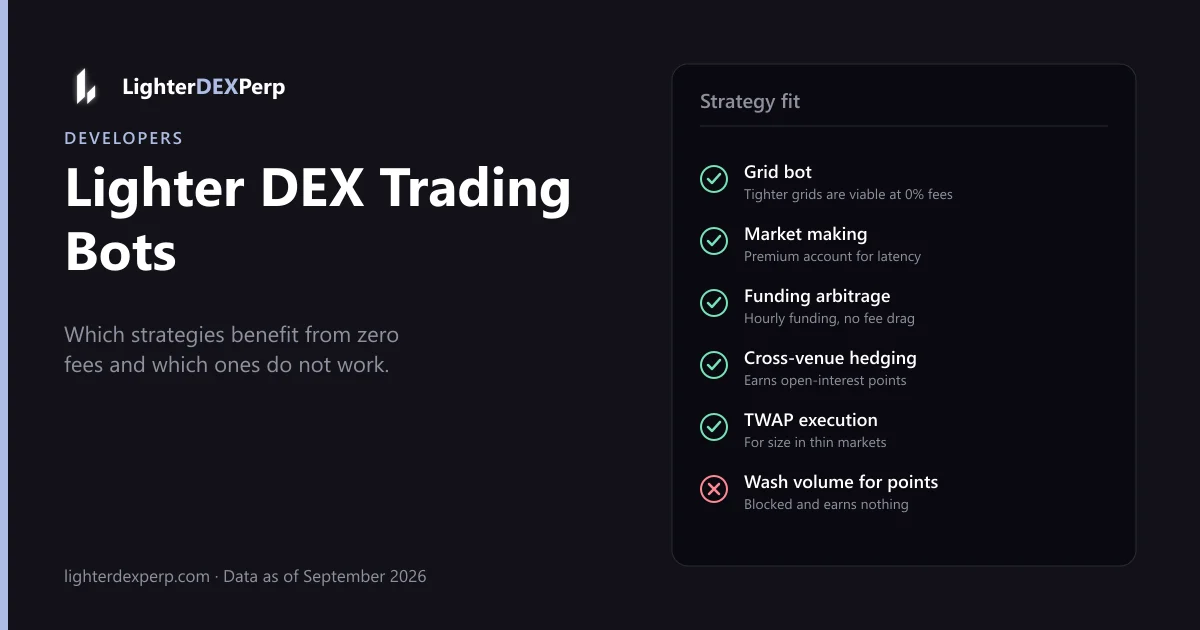
Lighter xyz is one of the best venues in crypto for trading bots, for one reason: standard accounts pay 0% maker and 0% taker fees, so strategies that lose money on fee-charging venues (tight grids, high-turnover mean reversion, small funding spreads) become viable here. You also get a documented REST and WebSocket API, official Python and Go SDKs, self-trade prevention, and a points program that rewards organic maker activity. Below you get which bot strategies fit Lighter, which account tier to use, where to start from open-source code, and the risk controls that matter more on a 50x venue than anywhere else. Verified September 2026.
Why zero fees change bot math
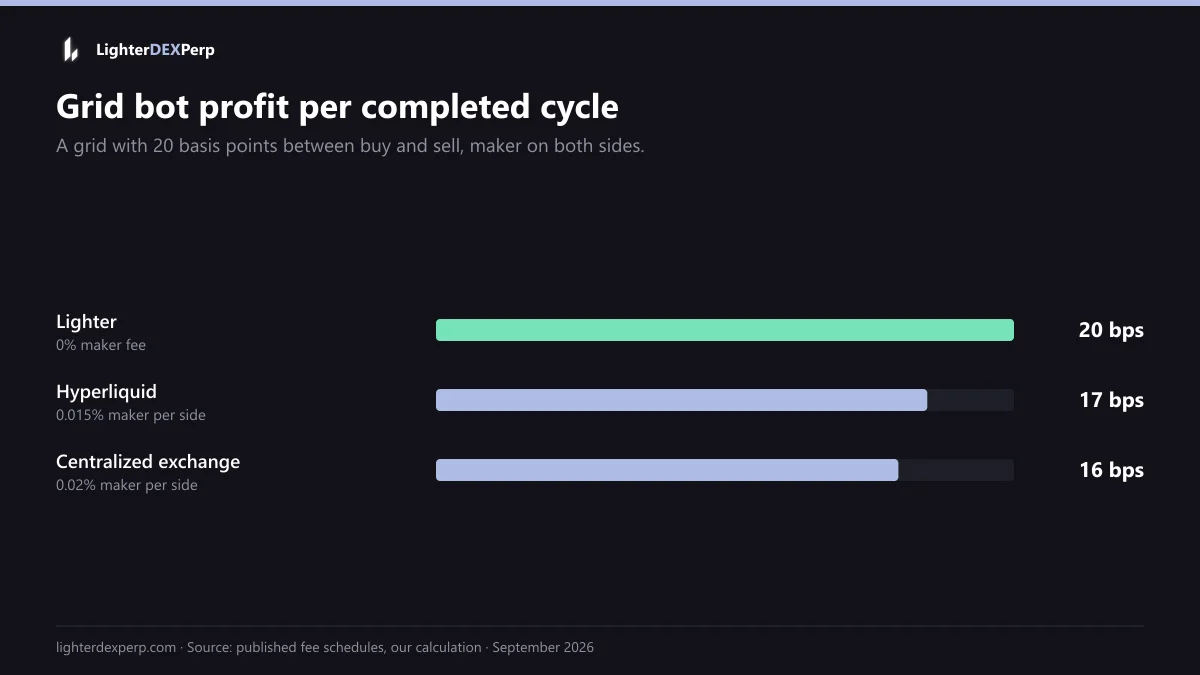
A grid bot placing a buy and a sell 20 bps apart earns 20 bps per completed cycle. On Hyperliquid at 1.5 bps maker per side, it nets 17 bps; on a CEX at 2 bps maker, 16 bps; on Lighter, the full 20 bps. That sounds small until you shrink the grid: a 5 bps grid is profitable on Lighter and loses money on fee-charging venues. The same applies to:
- Mean-reversion scalping with 5–15 bp targets.
- Funding arbitrage where the differential between venues is only a few bps per 8 hours.
- Rebalancing bots for delta-neutral positions that adjust hedges frequently.
- TWAP/VWAP execution for size, where every child order on a fee venue costs money.
The costs that remain, spread and adverse selection, are the same as anywhere. Bots that lose on Lighter lose because of bad fills, not fees. Fee detail: Lighter DEX spread and fees.
Which account tier does a bot need?
| Tier | Fees | Rate limit | Latency | Best for |
|---|---|---|---|---|
| Standard | 0% | Baseline | 300 ms taker | Grids, swing bots, funding arb, most retail automation |
| Plus | 0.005% flat | 8,000 sendTx/min | 300 ms | High-order-count bots that hit 429s on standard |
| Premium | 0.004%/0.028% minus LIT discount | High | 140–200 ms | Latency-sensitive market making; eligible for the 50k weekly MM points pool |
Start on standard. Use sendTxBatch to bundle order updates. Move to Plus only when rate limits bind, and to Premium only if queue position is worth 2.8 bps per taker fill to you. See the Lighter DEX Python SDK guide for endpoints, keys and SDKs.
Strategies that work on Lighter
Grid bot
Place a ladder of limit buys below and sells above the price on a range-bound market. Zero fees allow tighter grids. Use post-only orders so every fill is a maker fill (which also counts toward points), size the grid so total exposure at the bottom rung stays under 3x leverage, and add a hard stop that cancels everything if price exits the range. BTC, ETH and FX perps are the natural targets because of tight spreads; avoid tier-7 and tier-8 alts where the spread is wider than your grid step.
Market making
Quote both sides around mid, skew by inventory, cancel and replace on each order-book update. Standard accounts can do this, but at 300 ms taker latency you will be picked off by premium accounts on fast moves. Serious market makers use Premium plus LIT staking for the 20–30% discount and 140–160 ms latency, and compete for the 50,000-point weekly market-maker pool. The LLP vault is also a market maker on thin markets; there is room to compete on newly listed pairs where LLP quotes wide.
Funding arbitrage
Short the perp on Lighter and hold spot elsewhere (or the reverse) when Lighter funding diverges from other venues. Because Lighter pays funding hourly, the bot can rebalance every hour; because fees are zero, small differentials are worth capturing. Watch the ½ multiplier on RWA perps, which makes stock perps poor funding-arb targets. Mechanics: Lighter perp DEX funding.
Cross-venue hedging
Long on Lighter, short on Hyperliquid or a CEX, to capture basis or to hedge a spot portfolio while earning points on the Lighter leg. Lighter's open-interest points category rewards the held position.
Execution algos (TWAP, iceberg)
Lighter has native TWAP orders, but a custom execution bot can be smarter about participation rate and can pause on spread widening. Useful for moving $500k+ in mid-caps.
Strategies that do not work
- Wash-volume bots for points. Self-trade prevention blocks matching your own orders, and the points formula is non-linear with Sybil detection. It earns nothing and risks disqualification. See the Lighter DEX farming rules.
- Pure taker momentum at 50x. Zero fees do not help if you are liquidated. Lighter's partial-liquidation engine is fair but unforgiving.
- Latency arbitrage on standard accounts. You cannot outrun premium accounts with a 100–160 ms handicap.
Open-source starting points
- Official
lighter-pythonexamples: API-key setup, order create/cancel, WebSocket client. Foundation for any Python bot. - Hummingbot: community connectors for Lighter exist; check the Hummingbot connector list for current status before relying on one. Hummingbot gives you grid, pure market-making and cross-exchange strategies out of the box.
- Community lighter-ts: for Node.js bots; verify it tracks the latest API version.
- Freqtrade / Jesse: no native Lighter support as of September 2026; adapters exist in forks.
Whatever you start from, read the API updates Telegram before deploying. Signing schemes and market indices change with upgrades.
Risk controls that matter on Lighter
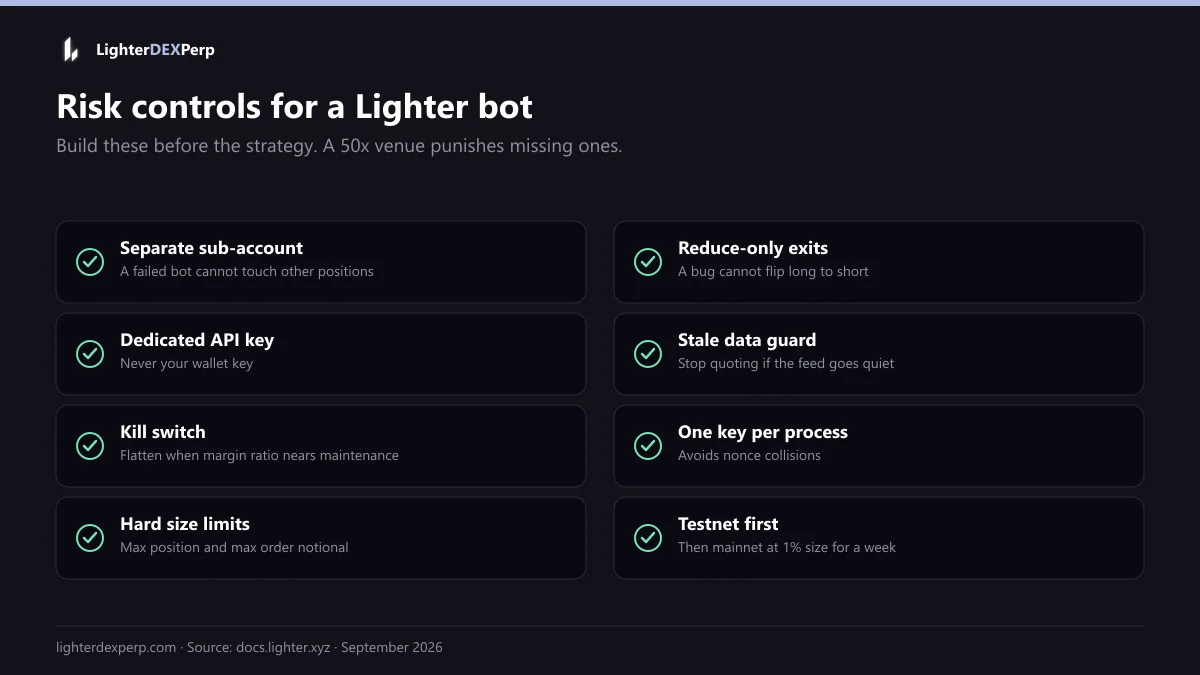
- Separate sub-account per bot. Up to four per wallet, isolated margin, and a blown bot does not touch your discretionary positions.
- API key per bot, never your wallet key. Register keys via
system_setup; revoke by overwriting the index. - Kill switch on margin ratio. Poll the account stream; if margin ratio approaches maintenance, cancel all and flatten. Do not rely on the exchange's partial liquidation as your stop.
- Max position and max order notional hard-coded, with a sanity check against
orderBookDetailsdecimals so a misplaced decimal does not send a 100x-size order. - Reduce-only exits so a bug cannot flip you from long to short.
- Stale-data guard. If the WebSocket has not delivered a book update in N seconds, stop quoting.
- Nonce handling. Each API key has its own nonce; use one key per process to avoid nonce collisions.
- Test on testnet first, then run on mainnet at 1% size for a week.
Bots and points
Bots earn points like humans do, as long as the flow is organic: maker fills, sustained open interest, funding participation, profitable PnL. A well-run grid or market-making bot on a mid-cap market is exactly the "quality volume" Lighter says it rewards. Lighter explicitly allows up to 10 accounts per user, but those accounts trading against each other earn nothing.
Frequently asked questions
Can I run a trading bot on Lighter DEX? Yes. REST and WebSocket APIs, official Python and Go SDKs, and 0% fees on standard accounts.
Is there a free Lighter grid bot? Hummingbot has community Lighter connectors; the official Python SDK examples are a starting point for writing your own.
Does a bot need a Premium account? No. Standard is fine for grids, arbitrage and swing automation. Premium is for latency-sensitive market making.
Do bots earn Lighter points? Yes, if the activity is organic. Wash trading earns zero.
Can a bot withdraw my funds? Withdrawals are transactions signed by an API key, so a compromised key could withdraw to your own L1 address only. Keep keys secret regardless.
Related guides
Related Lighter DEX guides
Developers
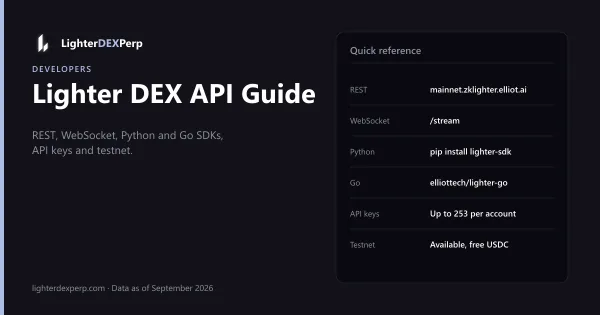
Lighter DEX API Guide: REST, WebSocket, Python and Go SDKs, GitHub, Testnet and Rate Limits (2026)
Endpoints, API keys, official Python and Go SDKs, TypeScript option, WebSocket channels, rate limits, testnet and a minimal signed-order example.
5 min read · Updated
Basics
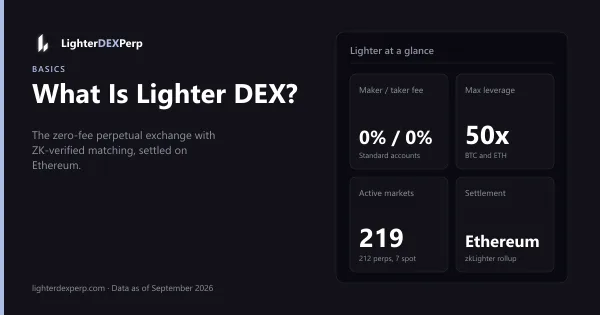
What Is Lighter DEX? The Zero-Fee ZK Perp Exchange Explained (2026)
Plain-English explanation of Lighter: the ZK rollup, the zero-fee model, the 219+ markets, the LIT token and the risks.
9 min read · Updated
Basics
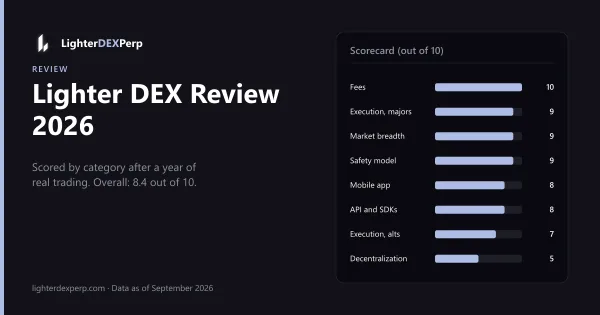
Lighter DEX Review 2026: Pros, Cons, Fees, Liquidity, Safety and Who It Is For
A year of real use distilled: what is excellent, what is merely fine, what is missing, scored by category, with a verdict per trader type.
6 min read · Updated