
Trading
Lighter DEX Funding Rate Explained: Hourly Formula, Caps, History and How to Farm It (2026)
Lighter DEX charges funding every hour, computed from the mark-index premium and clamped at 0.5% per hour. Learn the exact formula, why stock and pre-IPO perps use lower multipliers, where to see funding history, and how funding-rate arbitrage works on a zero-fee venue.
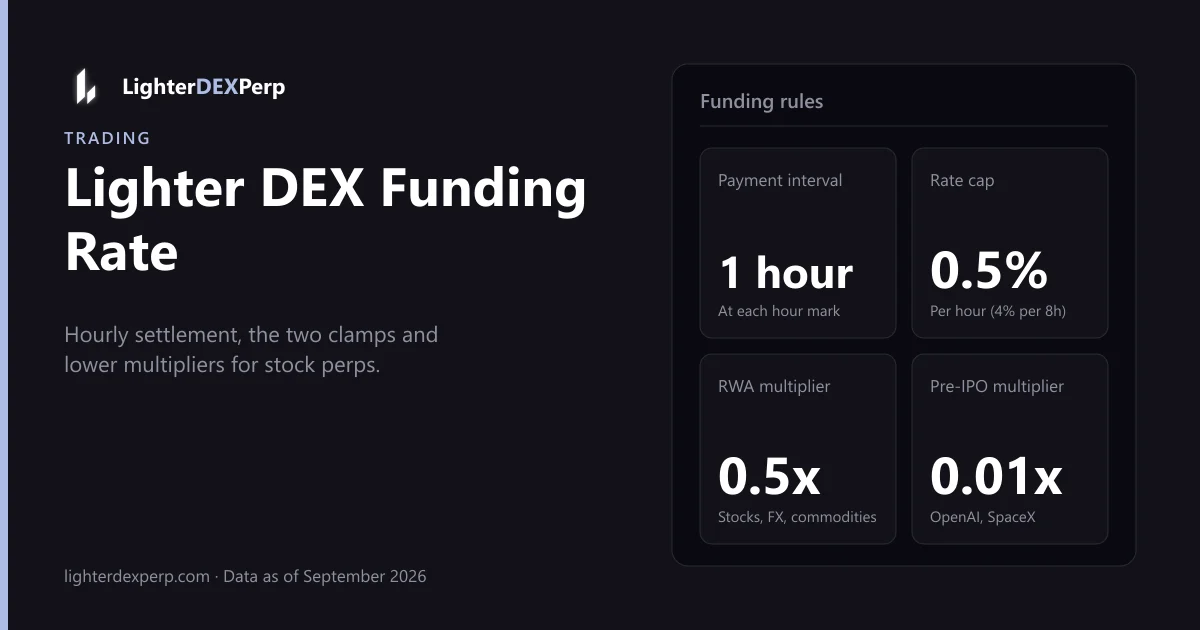
On Lighter perpetual DEX, funding is paid every hour, so the cost of holding a position is spread finely and never surprises you with one large 8-hour payment. Each hourly rate is one-eighth of an 8-hour-equivalent rate derived from how far the mark price sat above or below the index during that hour, clamped so no single hour can exceed 0.5% (4% per 8 hours). Stock, FX and commodity perps halve the premium component, and pre-IPO markets divide it by 100. Funding moves between longs and shorts; Lighter keeps none of it. On a zero-fee exchange it is usually your largest holding cost, and also the raw material for the delta-neutral strategies that dominated the points program. Below you get the formula, worked examples and how to earn funding instead of paying it. Verified against the official funding docs in September 2026.
The funding formula on Lighter
Every minute, at a random moment within the minute, Lighter samples the premium: how much the mark price deviates from the index price, expressed as a percentage. At the end of each hour it averages the sixty samples to get the hourly premium, then applies two clamps and an interest component:
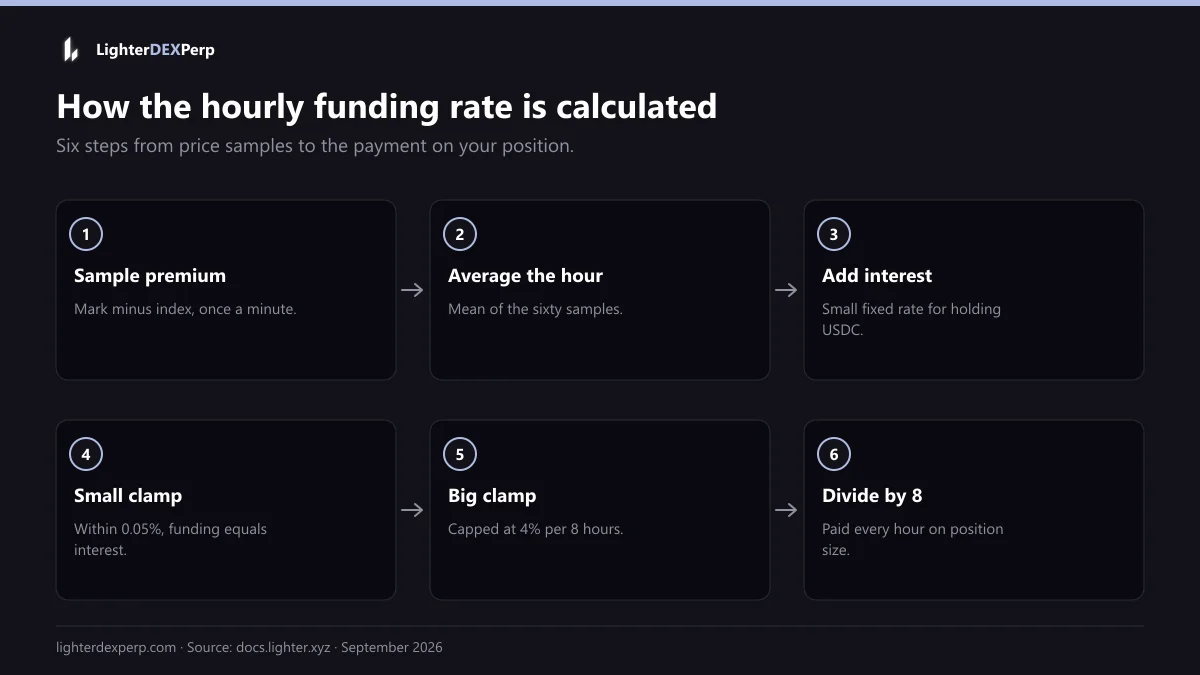
- Interest component. A small fixed rate reflecting the cost of holding USDC versus the asset, in line with industry convention (0.01% per 8 hours on most crypto perps).
- Small clamp (0.05%). If the premium is within ±0.05% of the interest rate, funding is set to the interest rate. This keeps funding near zero when the book is balanced.
- Big clamp. The result is capped at ±4% per 8 hours, i.e. ±0.5% per hour.
- Divide by 8. Because payments happen hourly rather than every 8 hours, the 8-hour-equivalent rate is divided by 8 to get the amount paid each hour.
Your payment each hour is:
funding = position size × index price × hourly funding rate
If the rate is positive, longs pay shorts. If negative, shorts pay longs. The amount is credited or debited from your margin balance at each hour mark, whether or not you are online, as long as the position is open at that moment.
Worked example
You are long 1 BTC at an index of $100,000. The hourly funding rate is +0.0025% (a 0.02% 8-hour equivalent, typical for a mildly bullish market).
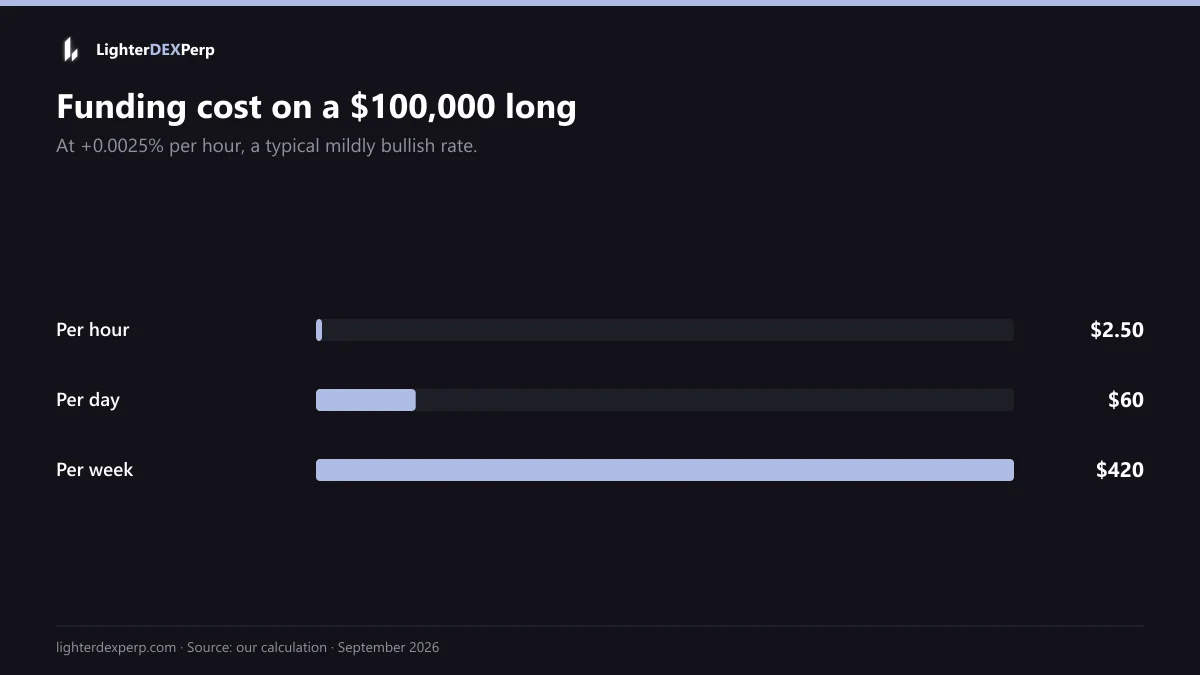
- Hourly payment: 1 × 100,000 × 0.000025 = $2.50 paid to shorts.
- Per day: $60. Per week: $420 on a $100,000 position, roughly 0.42% a week.
Compare that with the $0 trading fee. Over any holding period longer than a few hours, funding dominates cost.
Funding multipliers for stocks, FX, commodities and pre-IPO markets
Lighter applies a FundingPremiumMultiplier that scales the premium component:
| Market class | Multiplier | Effect |
|---|---|---|
| Crypto perps | 1.0 | Full premium |
| Stocks, FX, commodities (RWAs) | 0.5 | Half the premium |
| Pre-IPO and pre-launch markets | 0.01 | One-hundredth of the premium |
The rationale: RWA perps are priced off a rolling futures price rather than a spot index, so the premium already carries the futures basis, and pre-IPO markets have no liquid reference at all, so funding would otherwise be dominated by noise. In practice this means holding NVDA-PERP or a pre-IPO position for weeks costs very little in funding, whereas holding a crowded alt long can be expensive.
Where to see Lighter funding rate history
- In the app: each market's info panel shows the current hourly rate, the predicted next rate and a funding history table. The Funding tab under your account lists every payment you have made or received.
- API: the public REST endpoint for funding rates and the WebSocket market-stats stream expose current and historical rates per market. See the Lighter DEX API guide.
- Third-party dashboards: CoinGlass, Dune dashboards and funding-comparison sites list Lighter alongside Hyperliquid, Binance and Bybit. Because Lighter pays hourly, compare using 8-hour or annualized equivalents, not raw hourly numbers.
A month of Lighter funding history at a glance (September 2026, majors): BTC and ETH funding hovered between +0.005% and +0.015% per 8 hours during calm weeks, briefly negative in the mid-September drawdown; alt funding was more dispersed, with several tier-5 markets printing +0.05% to +0.1% per 8 hours during rallies, which is where funding arbitrage pays.
Funding rate arbitrage on Lighter
Because trading fees are zero, Lighter is unusually well suited to delta-neutral funding capture:
- Find a market where Lighter funding is materially higher than on another venue, or where Lighter funding is positive and you can hold the spot asset.
- Short the perp on Lighter (collecting funding from longs) and buy spot elsewhere, or long spot on Lighter's own spot market if listed.
- Hold. You earn the funding differential each hour with near-zero price exposure.
Costs and risks that fees do not tell you about:
- Spread on both legs. Entering and exiting a $50,000 position on a tier-5 alt can cost 20–50 bps in spread, which needs several days of funding to recover.
- Funding flips. Rates change every hour. Crowded funding trades unwind fast.
- Liquidation on the perp leg. A hedged position is still leveraged on Lighter. Keep leverage low (2–3x) and margin ample.
- Points bonus. Open interest and funding are scored categories in the Lighter DEX airdrop points program, so a funding-arb position also earns points. This is why the strategy was popular in Season 1.
How Lighter funding compares to other venues
| Venue | Interval | Cap | Notes |
|---|---|---|---|
| Lighter | 1 hour | 0.5%/hour (4%/8h) | RWA multiplier ½, pre-IPO 1/100 |
| Hyperliquid | 1 hour | 4%/hour | Premium sampled every minute similar to Lighter |
| Binance Futures | 8 hours (some 4h) | Varies by pair | Standard CEX model |
| dYdX v4 | 1 hour | Per market | Similar hourly design |
Hourly settlement means the amount per payment is small, but it also means you cannot dodge funding by closing before an 8-hour snapshot as you can on some CEXs; on Lighter you pay for every hour you hold.
Reading the funding rate as a signal
Persistently high positive funding on a market means longs are crowded and paying to stay long; it often precedes sharp long liquidations. Persistently negative funding means the reverse. Lighter DEX open interest and funding data together are one of the cleaner sentiment signals in perp DEXs because the book is verifiable and fee-free flow is less distorted by rebate farming.
Frequently asked questions
How often does Lighter DEX charge funding? Every hour, at the hour mark.
What is the maximum funding rate on Lighter? 0.5% per hour, equivalent to 4% per 8 hours.
Does Lighter keep the funding fee? No. Funding is paid between longs and shorts. Lighter's revenue comes from premium fees, liquidation fees and partnerships.
Why is funding so low on stock and pre-IPO perps? Lighter halves the premium for RWAs and divides it by 100 for pre-IPO markets, because those markets price off futures or have no liquid reference.
Where can I see historical funding rates? In each market's info panel, via the public API, and on aggregators such as CoinGlass.
Related guides
Related Lighter DEX guides
Trading
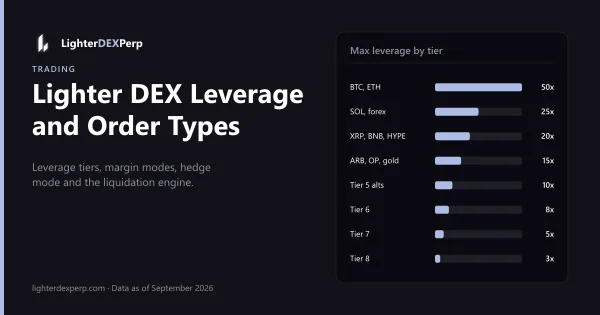
Lighter DEX Leverage, Order Types, Hedge Mode and Liquidations Explained (2026)
Leverage tiers for every market class, margin modes, hedge mode, all order types, how Lighter's zero-price liquidation engine works and where spot fits.
7 min read · Updated
Trading
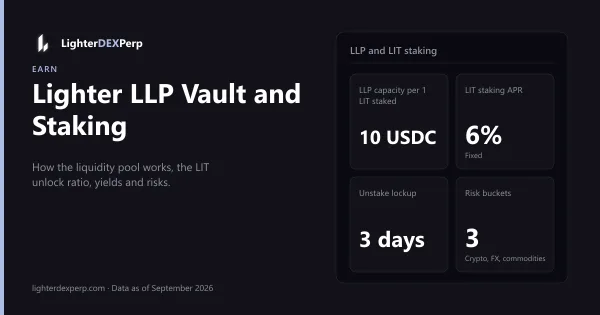
Lighter LLP Vault and Staking: How the Liquidity Pool Works, APY, Risks and the LIT Unlock (2026)
What LLP does, how the LIT-gated deposit works, the February 2026 bucket split, historical APY from 5% to 30%, public pools, and how to think about the risk.
6 min read · Updated
Trading
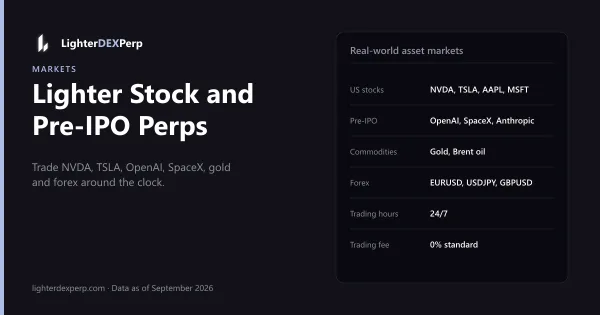
Lighter Stock, Pre-IPO and RWA Perps: Trade NVDA, TSLA, OpenAI, SpaceX, Gold and Forex 24/7 (2026)
How Lighter prices stock, commodity, FX and pre-IPO perps when the underlying market is closed, what leverage and funding apply, and how to trade them sensibly.
5 min read · Updated