
Trading
Lighter DEX Leverage, Order Types, Hedge Mode and Liquidations Explained (2026)
Everything about trading mechanics on Lighter DEX: leverage tiers per market (50x BTC/ETH down to 3x), cross vs isolated margin, hedge mode, every order type including TWAP and post-only, the three-stage liquidation engine and spot trading.
Lighter xyz gives you up to 50x leverage on BTC and ETH, tiered lower on other markets, with cross or isolated margin, hedge mode for holding long and short at the same time, a full set of order types including TWAP and post-only, and a three-stage liquidation engine that is provably fair because it runs inside the same ZK circuits as matching. Below is the trading-mechanics reference you need before sizing a position: what leverage each market allows, how margin and liquidation really work, and which order type to use when. Verified against the contract specifications and liquidation docs in September 2026.
Leverage tiers by market
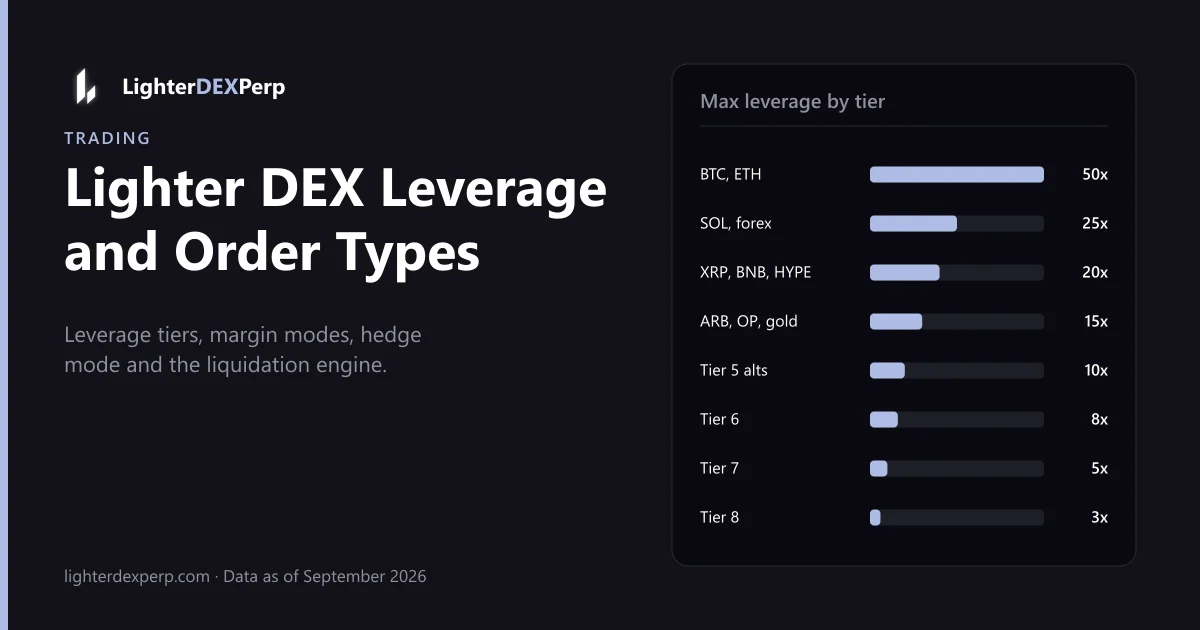
Lighter perps are grouped into tiers with different maximum leverage and margin requirements. Mainnet tiers as of September 2026:
| Tier | Max leverage | Markets (examples) |
|---|---|---|
| 1 | 50x | BTC, ETH |
| 2 | 25x | SOL, EURUSD, GBPUSD, USDJPY, USDCHF, USDCAD |
| 3 | 20x | XRP, BNB, HYPE |
| 4 | 15x | ARB, OP, XAU (gold) |
| 5 | 10x | DOGE, ADA, LTC, SEI, TON, BCH, LDO, TRUMP, XMR, JUP and 30+ others |
| 6 | 8x | POL, PUMP, ZK, PAXG, PENGU |
| 7 | 5x | TAO, PENDLE, PYTH, STRK, ICP, MNT, VIRTUAL and 15+ others |
| 8 | 3x | Long-tail listings: AERO, ZORA, MYX, VVV and others |
| Stocks | 5–20x | NVDA, TSLA, AAPL, MSFT, GOOGL, META, COIN |
| Pre-IPO | Low, isolated only | OpenAI, SpaceX, Anthropic |
Tiers change as liquidity changes; the in-app leverage slider always shows the current maximum. You can set a lower leverage than the maximum for any market, and the setting applies per market per sub-account.
Max leverage is the ratio of position notional to initial margin. 50x means 2% initial margin. Maintenance margin is lower than initial, and a third "close-out" margin below that triggers full liquidation.
Cross vs isolated margin
- Cross margin: all positions in the account share the full available balance as collateral. Profits on one position support losses on another. Efficient, but one bad position can liquidate everything.
- Isolated margin: each position has its own AllocatedMargin. Losses are capped at that margin; you can add or remove margin manually. Isolated positions follow the same liquidation rules independently.
Rule of thumb: isolated for directional bets and anything above 10x; cross for hedged books and market-making.
Hedge mode
Lighter supports hedge mode, which lets an account hold a long and a short in the same market simultaneously instead of netting them. Use cases:
- Locking in a gain without closing (and without realizing PnL or resetting the funding clock).
- Running two strategies on one market from one sub-account.
- Farming funding: long and short on the same market earn or pay funding in opposite directions, so a hedged pair is neutral, but paired across correlated markets it can capture funding differentials.
If hedge mode is off (one-way mode), a sell order on a long position reduces it. The setting lives in the account or trade settings. Alternatively, use separate sub-accounts (up to four) for the same effect with cleaner accounting.
Order types on Lighter
| Order type | What it does | When to use |
|---|---|---|
| Market | Fills immediately against the book | Small sizes on liquid markets; getting out fast |
| Limit | Rests at your price or better | Default for entries; earns maker status |
| Post-Only | Limit that is rejected if it would take | Guarantee maker execution |
| Reduce-Only | Can only decrease a position | Exits and stops that must never flip you |
| Stop-Loss / Stop-Market | Triggers a market order at a mark price | Every leveraged position |
| Stop-Limit | Triggers a limit order at a mark price | Exits where slippage control matters more than certainty |
| Take-Profit | Trigger order at a favourable price | Locking gains |
| TWAP | Slices size over a time window | Size larger than top-of-book depth |
| IOC / FOK | Immediate-or-cancel / fill-or-kill | API and bot execution |
Time in force for limit orders: GTC (good till cancel), IOC, FOK, and Post-Only. Triggers for stop and take-profit orders fire on the mark price, not the last trade, which protects against wicks on thin books.
Matching is price-time priority: better price first, then earlier order. There is no maker rebate on Lighter (fees are already zero for standard accounts), but maker fills count toward points and market-maker points are reserved for premium accounts.
Self-trade prevention
If your buy order would match your own sell order (across sub-accounts on the same address), Lighter's self-trade prevention cancels rather than fills, which also means you cannot accidentally wash-trade points. Details in the docs' Self-Trade Prevention page.
Fair-price marking
Liquidations and unrealized PnL use a mark price built from external index prices and the local book, smoothed to resist manipulation. On stock and commodity markets, which trade 24/7 on Lighter while the underlying market is closed, the mark uses a futures price rolling mechanism and the last reference price. This is why stock perps can move on weekends: they track futures and expected open, not a stale close. See Lighter DEX stocks and pre-IPO perps.
How Lighter liquidations work
Lighter defines three margin thresholds per market, from highest to lowest: initial (I), maintenance (M) and close-out (C). Your account moves through four states:
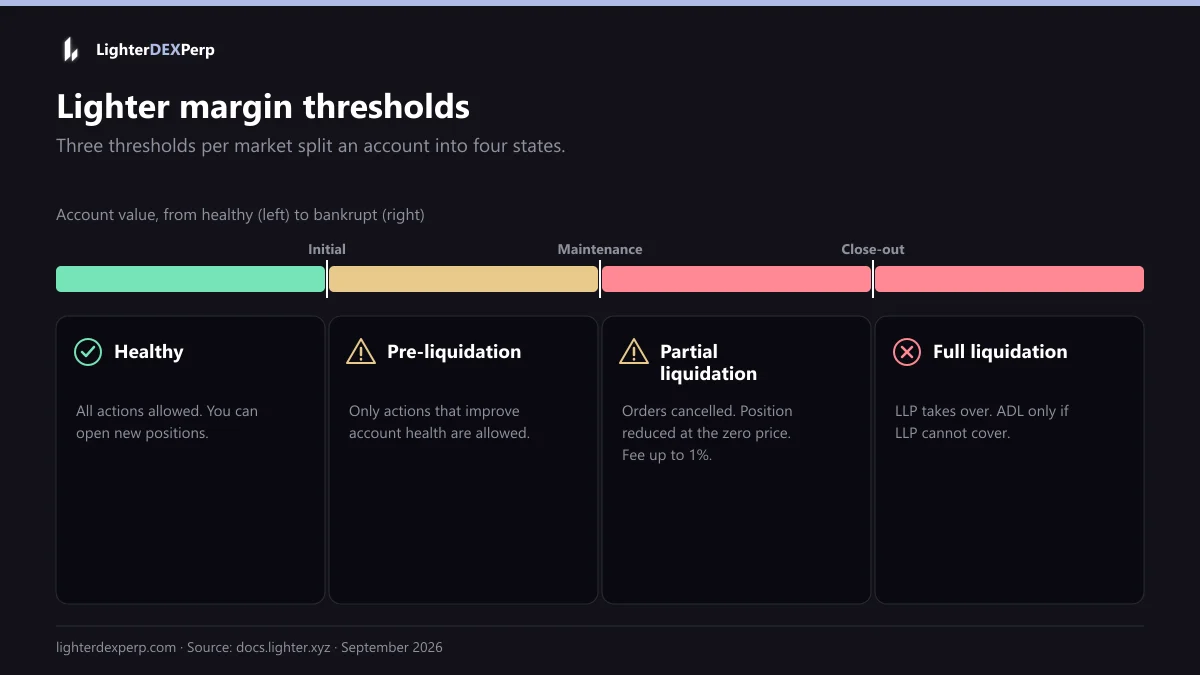
- Healthy: account value above initial margin. Everything allowed.
- Pre-liquidation: between initial and maintenance. You may only take actions that improve health: add margin, reduce positions, cancel orders. Opening new risk is blocked.
- Partial liquidation: between maintenance and close-out. The engine cancels your open orders, then executes IoC limit orders at a "zero price", a price calculated so that the trade keeps your account-value-to-maintenance-margin ratio constant. Each partial liquidation can only improve your health. If the fill is better than the zero price, the engine takes up to 1% of the improvement as a liquidation fee for the LLP fund; the rest is yours.
- Full liquidation: below close-out margin. The LLP (Lighter Liquidity Pool, the insurance fund) takes over positions in ascending PnL order at bankruptcy price, provided it has capital.
If an account goes bankrupt and LLP cannot absorb it, auto-deleveraging (ADL) closes opposing profitable positions at their zero prices, chosen so that no counterparty's health deteriorates. ADL is rare and is the reason very profitable positions in illiquid markets are occasionally closed early during crashes.
Because all of this runs inside the ZK-proven state transition, Lighter cannot liquidate you above your maintenance margin or fill a liquidation at a worse-than-zero price without producing an invalid proof. That is the practical meaning of "verifiable liquidations." The insurance economics are covered in the Lighter DEX vault.
Latency and execution quality
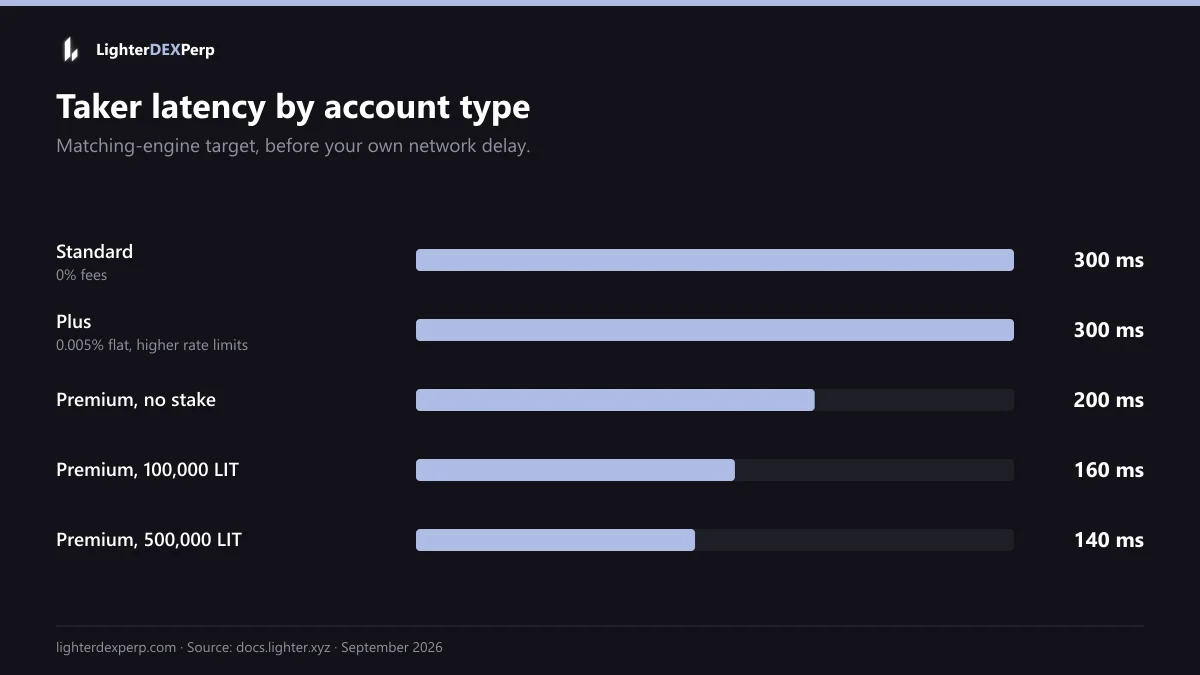
Standard accounts get 300 ms taker latency and 200 ms maker latency; premium accounts 140–200 ms. That is the matching-engine target, not your network round trip. Lighter's sequencer is centralized, so execution is CEX-fast, and the ZK proof is generated afterward in batches without slowing matching.
Slippage on BTC and ETH is negligible for orders under a few hundred thousand dollars. On tier 5–8 alts, stocks and pre-IPO markets, use limit or TWAP orders for anything above the visible top-of-book size. Spread, not fees, is the real cost on those markets; see Lighter DEX no fees and what it does not cover.
Spot trading on Lighter
Lighter lists a small set of spot pairs (7 as of September 2026) alongside 212 perps. Spot on Lighter is order-book spot, not an AMM, with the same zero fees. It exists mainly for LIT and a few majors; perps remain the core product. Multi-asset margin currently applies to perps only.
Funding
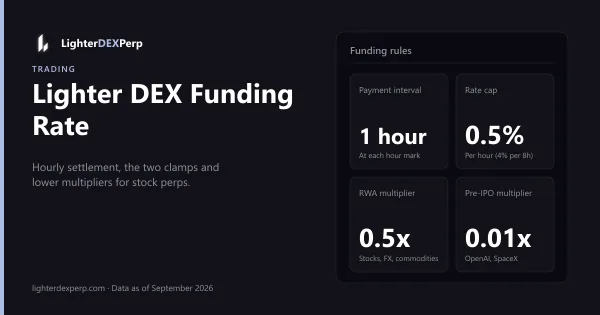
Funding on Lighter settles hourly, capped at 0.5% per hour, with reduced multipliers for stock/FX/commodity (½) and pre-IPO (1/100) markets. If you hold positions for more than a few hours, funding is your main cost. Full mechanics: Lighter DEX funding rate.
Practical guidance by strategy
- Scalping majors: cross margin, 5–20x, limit entries, market exits, stops on mark. Zero fees make sub-10-bp scalps viable, which is impossible on fee-charging venues.
- Swing trading alts: isolated, 2–5x, wide stops, size to the spread.
- Funding arbitrage: hedge mode or two sub-accounts, watch the hourly rate, remember the ½ multiplier makes stock perps poor funding-farming targets.
- Pre-IPO speculation: isolated only, tiny size, expect 30–60 bp spreads and long holding periods.
Frequently asked questions
What is the maximum leverage on Lighter DEX? 50x on BTC and ETH. Other markets range from 25x down to 3x by tier.
Does Lighter DEX have hedge mode? Yes. You can hold long and short in the same market, or use sub-accounts.
Does Lighter DEX have spot trading? A small number of spot pairs. Perps are the main product.
What is the liquidation fee on Lighter? Up to 1% of the improvement over the zero price during partial liquidation, paid to the LLP insurance fund.
How fast is Lighter's matching? 300 ms taker target on standard accounts, 140–200 ms on premium.
Can I use a stop-loss on Lighter? Yes, stop-market and stop-limit orders triggered on mark price, plus take-profit.
Related guides
Related Lighter DEX guides
Trading
Lighter DEX Funding Rate Explained: Hourly Formula, Caps, History and How to Farm It (2026)
The hourly funding formula, the two clamps, RWA multipliers, how to read funding history, and delta-neutral funding farming on Lighter.
6 min read · Updated
Trading
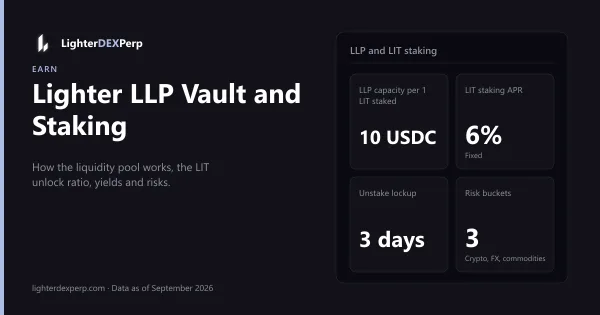
Lighter LLP Vault and Staking: How the Liquidity Pool Works, APY, Risks and the LIT Unlock (2026)
What LLP does, how the LIT-gated deposit works, the February 2026 bucket split, historical APY from 5% to 30%, public pools, and how to think about the risk.
6 min read · Updated
Trading
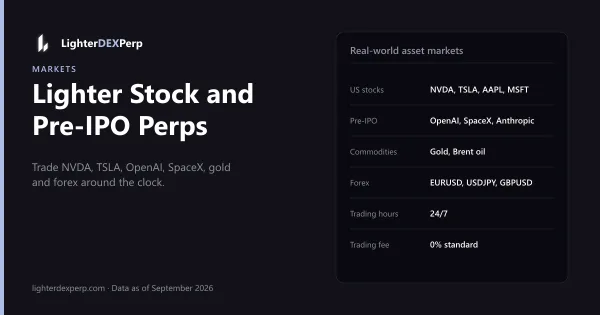
Lighter Stock, Pre-IPO and RWA Perps: Trade NVDA, TSLA, OpenAI, SpaceX, Gold and Forex 24/7 (2026)
How Lighter prices stock, commodity, FX and pre-IPO perps when the underlying market is closed, what leverage and funding apply, and how to trade them sensibly.
5 min read · Updated