
Basics
Lighter DEX Whitepaper and Architecture: How the zkLighter Chain Works (TPS, Latency, Proofs, Explorer)
A plain-English reading of the Lighter whitepaper and L2BEAT data: what chain Lighter runs on, how the sequencer, prover and Ethereum contracts fit together, throughput and latency claims, the Plonky2 proof system, data availability, the escape hatch, who controls upgrades, and why there is no block explorer.
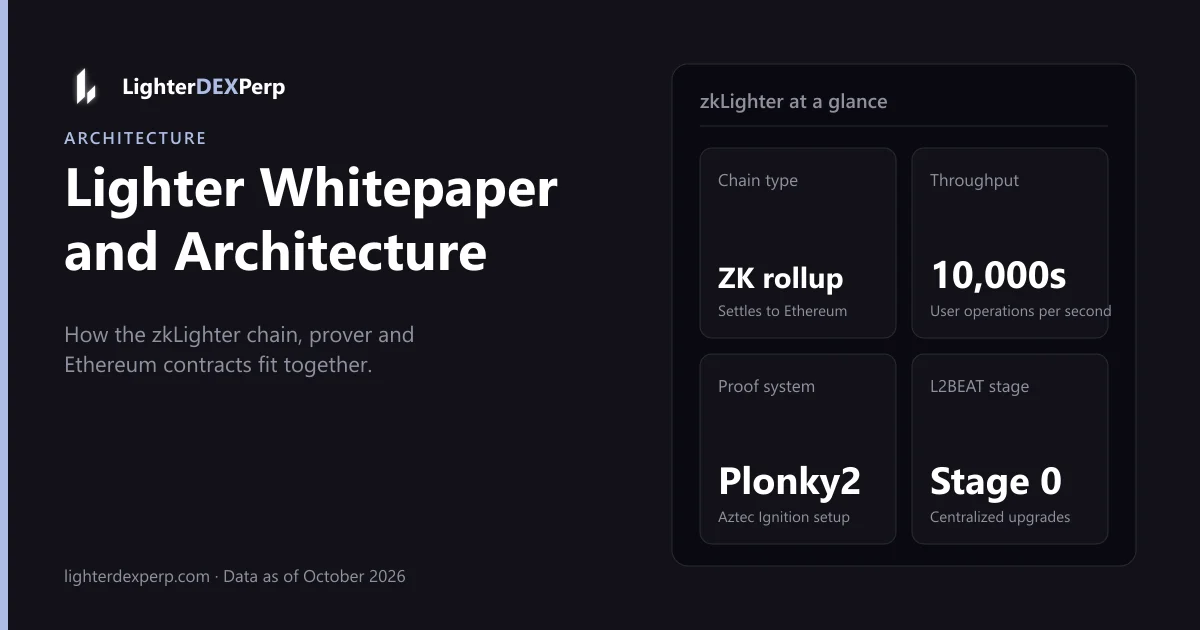
Lighter publishes a whitepaper, "Lighter Protocol: Order Book Matching and Liquidations with Transparent and Verifiable Computation" (Elliot Technologies, Inc., October 2025, 23 pages), plus a technical architecture section in its docs. Together with L2BEAT's review, they answer what you need to know before trusting the exchange with size: what chain Lighter perp DEX is on, how fast it is, how the proofs protect you, where the data lives, and what could still go wrong. Below is all of it in plain English. Verified against docs.lighter.xyz, the whitepaper PDF and L2BEAT in October 2026.
The short version
- Chain: Lighter runs on zkLighter, an application-specific ZK rollup that settles to Ethereum mainnet. It is not an independent L1 and not a general-purpose L2. A second deployment runs on Robinhood Chain.
- Speed: the whitepaper says Lighter "executes tens of thousands of user operations per second"; soft finality is sub-10 milliseconds; the published matching latency is 300 ms taker on standard accounts and 140–200 ms on premium.
- Proofs: custom Plonky2 circuits prove matching, margin and liquidation logic; proofs are wrapped into a Plonk proof verified on Ethereum using the Aztec Ignition trusted setup.
- Data: state-transition data is posted to Ethereum as blobs, so anyone can reconstruct balances without Lighter.
- Exit: if the operator stops for 14 days, the escape hatch ("desert mode") lets users withdraw on Ethereum with a ZK proof of balance.
- Trust: L2BEAT rates Lighter Stage 0. Three operator-controlled validators post batches, and a multisig can upgrade contracts without a delay. Fairness is proven; liveness and upgrades still rely on Lighter.
What chain is Lighter DEX on?
Lighter is its own chain, zkLighter, purpose-built to run one application: a central limit order book with a perpetual margin engine. Every account, order and position lives in zkLighter's state. That state is committed to Ethereum as a state root, together with the compressed data needed to rebuild it. Deposits enter through an Ethereum contract; withdrawals leave through the same contract once the batch containing them is proven.
Why not use Arbitrum or Hyperliquid's model? The whitepaper argues that general-purpose L2s cannot give market makers the throughput and cost to maintain tight spreads in volatile markets, and that finance-specific L1s such as Hyperliquid or dYdX v4 achieve speed by trusting a validator set rather than by proving execution. zkLighter's answer is a dedicated virtual machine for trading whose every state transition is proven. Lighter's own 2023 spot exchange on Arbitrum was the experiment that led here; see the Lighter DEX launch history.
"Lighter ETH DEX" is therefore half right: Ethereum is the settlement and data layer, but trading happens on zkLighter.
The five components of Lighter Core
Lighter's docs describe the system as five parts:
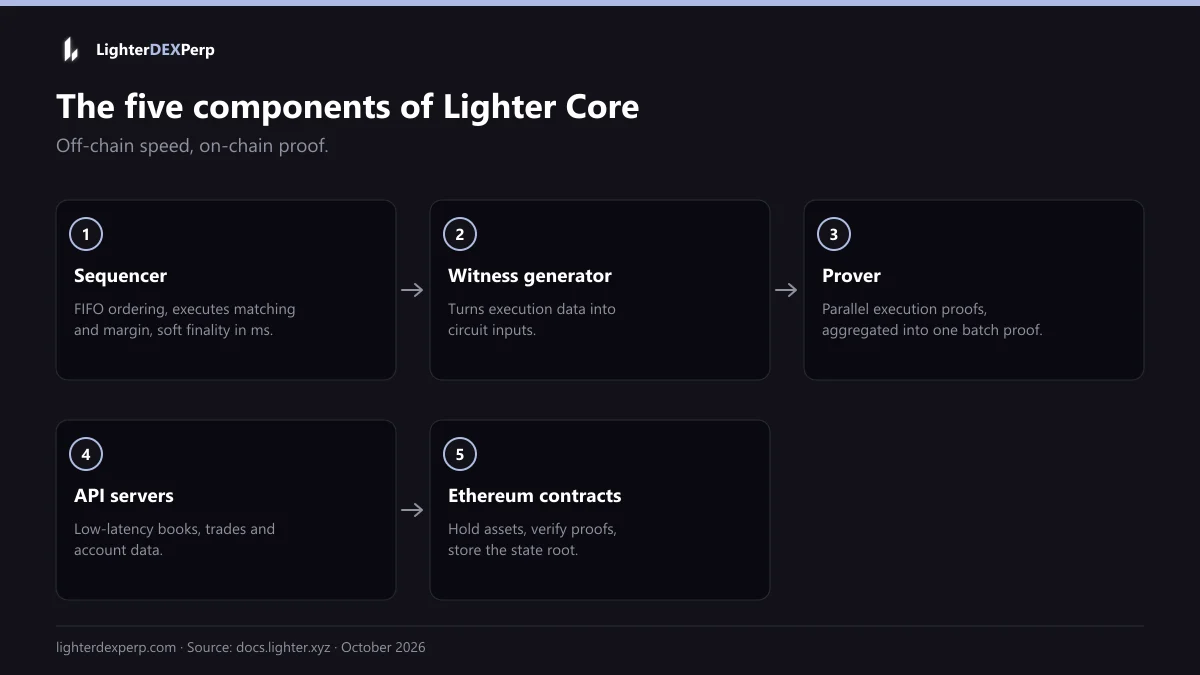
- Sequencer. Orders transactions first-in-first-out, executes the exchange logic (matching, margin checks, funding, liquidations) and gives traders soft finality within milliseconds. Users see fills instantly; Ethereum confirms later.
- Witness generator. Converts the sequencer's execution trace into inputs the circuits can consume.
- Prover. Generates "succinct execution proofs" for transactions in parallel, then feeds "hundreds of thousands" of them into a multi-layer aggregation engine that folds them into a single batch proof.
- API servers. Serve order books, trades and account data at low latency to the app and to bots. See the Lighter DEX WebSocket and REST API guide.
- Smart contracts on Ethereum. Hold deposited assets, store the canonical state root, verify each batch proof, process the priority queue for deposits and exits, and run the escape hatch.
The design principle stated in the docs is that users "always maintain custody of their assets" and "must always be able to exit securely and independently."
How fast is Lighter? TPS and latency
Three different numbers get mixed up in "Lighter DEX TPS" searches:
| Measure | Figure | Source |
|---|---|---|
| Execution throughput | "Tens of thousands of user operations per second" | Whitepaper, October 2025 |
| Soft finality | Sub-10 ms | Lighter technical materials |
| Taker matching latency | 300 ms standard, 200 ms premium, 140 ms at 500k LIT staked | Fee docs |
| Ethereum finality | When the batch proof is verified on L1, typically minutes to an hour | L2BEAT |
Orders per second is what the sequencer can process. Matching latency is the time budget Lighter gives each account tier before an order is matched, which is a product decision, not a hardware limit. Ethereum finality is when a withdrawal can leave. The October 10, 2025 outage happened because record throughput outgrew the database, which is the practical ceiling that matters more than the theoretical one. See Lighter DEX maintenance and incident history.
Because execution is centralized in one sequencer, Lighter can match at CEX speeds. Because every batch is proven, that speed does not require trusting the sequencer to match fairly. The whitepaper also notes that with millisecond-scale latency, any reordering advantage is "confined to millisecond-scale windows" and negligible in practice; it does not claim reordering is cryptographically impossible.
The proof system
- Circuits. Matching by price-time priority, margin tiers, funding, the three-stage liquidation waterfall and auto-deleveraging are all written as constraints. A state transition that violates them cannot be proven.
- Plonky2 and Poseidon2. L2BEAT records a prover migration in September 2026 from a gnark-based system with MiMC hashing to Plonky2 with Poseidon2 hashing, after which Lighter published a full state snapshot so the chain remained reconstructable. Lighter's circuits were originally audited by zkSecurity in April 2024.
- On-chain verification. Batch proofs are wrapped into a Plonk proof whose verifier is hardcoded in the Ethereum contracts. The trusted setup is the Aztec Ignition ceremony, which L2BEAT classifies as lowest risk.
- Two circuits matter for users: the main operation circuit and the exit-hatch ("desert") circuit, which proves a balance for direct withdrawal when the operator is gone.
What a proof covers and what it does not is spelled out in the Lighter DEX security guide.
Data availability: where is the data?
Lighter posts the data for every state transition to Ethereum as blobs, "highly compressed," so it does not depend on an external data-availability committee. That is why Lighter is classified as a ZK rollup, not a validium. If Lighter's servers disappeared, the blobs plus the last state root are enough to rebuild every balance, which is what the escape hatch relies on.
Is there a Lighter DEX explorer or scan?
No. zkLighter has no public block explorer like Arbiscan, because it is not a general-purpose chain with user-deployable contracts. What exists instead:
- Etherscan: Lighter's rollup contracts, deposits, withdrawals, batch commitments and proof verifications are ordinary Ethereum transactions.
- L2BEAT: tracks state updates, proof submissions, liveness anomalies, TVS and risk ratings for Lighter.
- The public API: order books, trades, candles, funding and account history at the transaction level. Third-party dashboards on Dune and DefiLlama are built on it. See Lighter DEX daily volume data.
- Robinhood Chain (the second deployment) is Arbitrum-based and has a standard explorer.
Can you run a Lighter node?
Not in the Ethereum sense. The sequencer and prover are operated by Lighter; there is no public full-node client to sync zkLighter in real time. L2BEAT notes that node source code is available, which is one of the Stage 0 requirements, and that lets a motivated party reconstruct state from Ethereum data. For day-to-day use, developers interact through the API.
Who controls the chain? L2BEAT's assessment
L2BEAT rates Lighter Stage 0 ("appchain" category) and lists these facts as of October 2026:
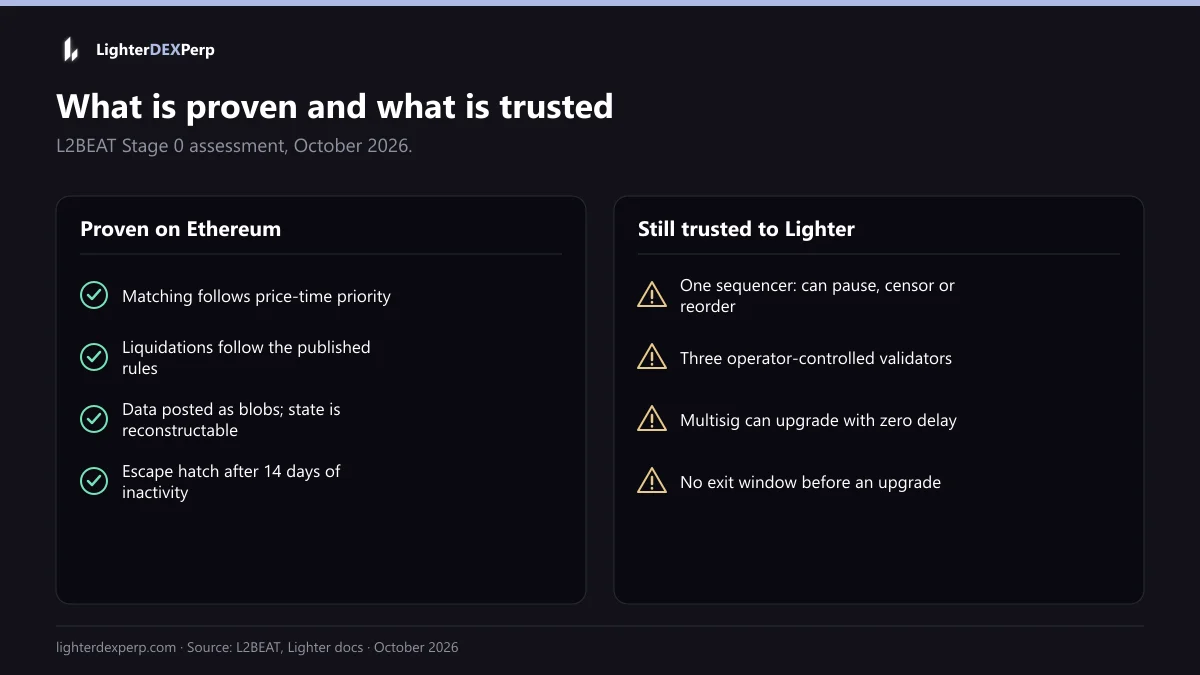
- Validators: three externally owned accounts controlled by Lighter commit and verify batches. There is no decentralized sequencer, so the operator could censor or reorder, and L2BEAT flags that as an MEV risk.
- Upgrades: a 3-of-5 multisig controls upgrades through a gatekeeper with a nominal 21-day delay, but a 4-of-7 multisig can reduce that delay to zero. L2BEAT's critical finding: "Funds can be stolen if a contract receives a malicious code upgrade. There is no delay on code upgrades."
- Exit window: none for an unwanted upgrade, because upgrades can be instant.
- Escape hatch: after 14 days of operator inactivity, users can exit via ZK proofs of balance without the operator.
- Total value secured: about $1.25 billion in October 2026, of which roughly half is stablecoins and 47% is LIT itself.
So the honest summary is: matching and liquidations are verifiable, custody is non-custodial, but governance is centralized. Lighter can prove it did not cheat you; it cannot yet prove it will not change the rules. Reaching Stage 1 would require a proper security council and a real exit window.
Where to read the primary sources
- Whitepaper:
assets.lighter.xyz/whitepaper.pdf(23 pages, October 2025). - Technical architecture: docs.lighter.xyz, "Technical Architecture: Lighter Core".
- Security: docs.lighter.xyz "Security Audits" and the zkSecurity public report (April 2024).
- Independent review: l2beat.com, project "Lighter".
Frequently asked questions
Does Lighter DEX have a whitepaper? Yes: "Lighter Protocol: Order Book Matching and Liquidations with Transparent and Verifiable Computation," October 2025, hosted at assets.lighter.xyz.
What blockchain is Lighter DEX built on? Its own ZK rollup, zkLighter, settling to Ethereum. A second deployment runs on Robinhood Chain.
What is Lighter DEX's TPS? The whitepaper claims tens of thousands of user operations per second. Matching latency for traders is 140–300 ms depending on account tier.
Is there a Lighter DEX block explorer? No. Use Etherscan for the rollup contracts, L2BEAT for liveness and risk, and the public API for trade data.
Is Lighter decentralized? Execution is proven, custody is non-custodial, but the sequencer and upgrade keys are controlled by Lighter. L2BEAT rates it Stage 0.
Related guides
Related Lighter DEX guides
Basics
What Is Lighter DEX? The Zero-Fee ZK Perp Exchange Explained (2026)
Plain-English explanation of Lighter: the ZK rollup, the zero-fee model, the 219+ markets, the LIT token and the risks.
9 min read · Updated
Basics
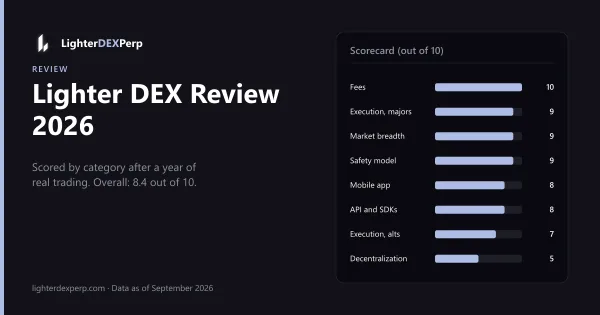
Lighter DEX Review 2026: Pros, Cons, Fees, Liquidity, Safety and Who It Is For
A year of real use distilled: what is excellent, what is merely fine, what is missing, scored by category, with a verdict per trader type.
6 min read · Updated
Basics
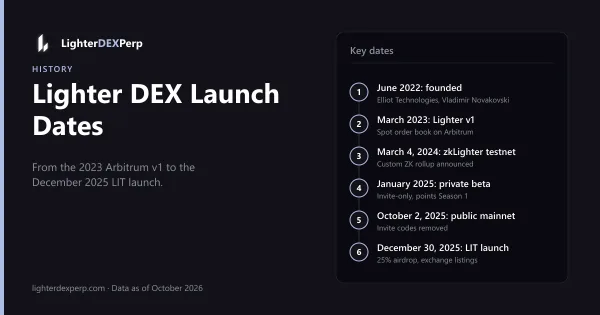
Lighter DEX Launch Date and History: From Arbitrum v1 to zkLighter, Mainnet and the LIT Listing
The full dated timeline: 2022 founding, the Arbitrum v1, the zkLighter testnet, private beta, the October 2025 mainnet, the December 30 2025 LIT launch and listings, and what changed in 2026.
6 min read · Updated